In the biopharmaceutical industry, liquid filters play an indispensable role. But how exactly do they work their filtration magic? The "Know Your Filter Core" knowledge series is here to unveil the working principles behind this remarkable technology!
The fundamental working principle of a liquid filter is to allow liquid to pass through membrane pores while removing particles that are too large to pass through those apertures.
The particle removal process typically involves two mechanisms:
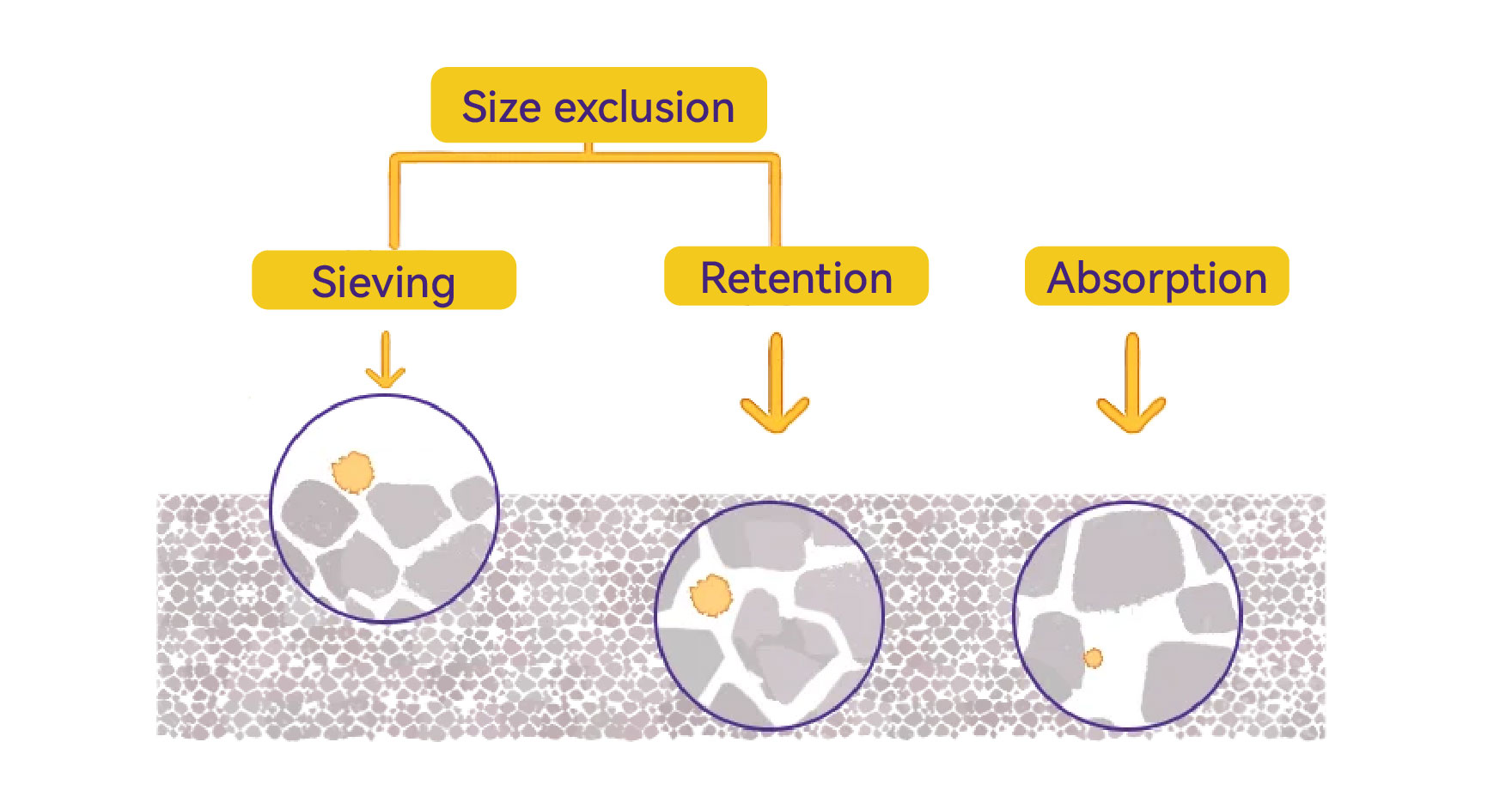
The first is size exclusion. This concept is based on geometric principles—particles that are too large simply cannot pass through the membrane pores. Size exclusion encompasses both surface sieving on the filter membrane and internal retention within the filter membrane. If every particle challenging the filter is too large to pass through the membrane pores, then the sheer number of particles will not affect the filtration performance. As long as the pressure does not cause deformation of either the particles or the membrane pores, particle breakthrough will not occur.
The second mechanism is absorption. Some small particles are not large enough to be removed by size exclusion and manage to enter the interior of the filter membrane, yet they may still be captured by the membrane. This indicates that particle retention may also depend on other operating conditions that influence the filtration process. These effects become particularly important when bacteria smaller than the membrane pores are present.
Absorption depends on the surface chemical properties of the filter membrane under the filtration process conditions, as well as the type of microorganism or particle. Many different operating conditions can affect the absorption capacity of the filter membrane, including pressure differential, flow rate, particle concentration, and liquid composition characteristics such as surface tension, pH, and ionic strength. These factors should all be taken into consideration during filtration process validation.
For a visual summary, please refer to the accompanying diagram.