
Saturated Steam
Dry saturated steam is a highly effective heat transfer medium. At a given temperature and pressure (dew point), saturated steam exists in equilibrium with water. When saturated steam contacts a cold surface, it rapidly condenses and transfers latent heat to the system. This phase change from vapor to liquid releases latent heat and generates moisture to inactivate microorganisms. The heat transferred by 1 kg of condensing steam is equivalent to the heat released by 100 kg of non-condensing steam cooling by 10 °C.
Using saturated steam at lower pressure actually provides the most effective sterilization efficacy, as it delivers more energy upon condensation than high-pressure steam.
As shown in the table below, the latent heat provided during steam condensation decreases as pressure increases. Meanwhile, low-pressure steam can extend the service life of filters and system components, reducing maintenance costs.
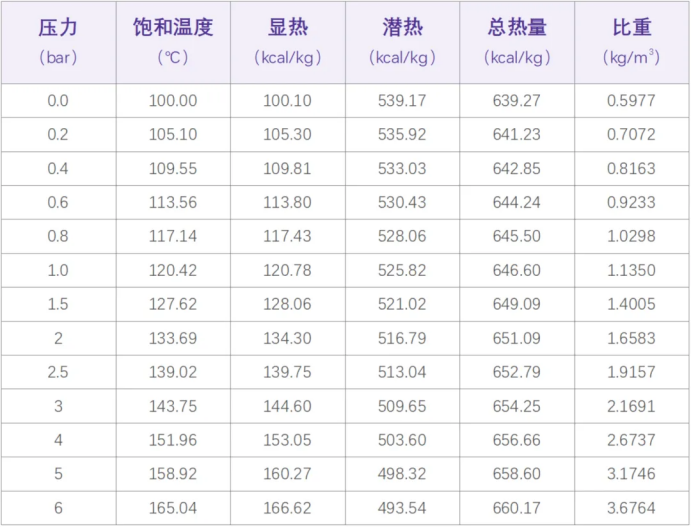
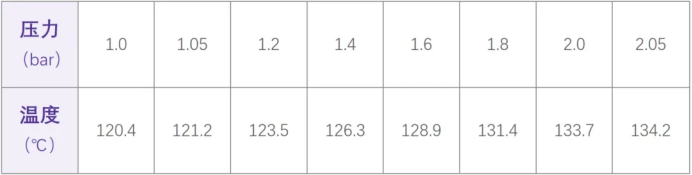
The figure below illustrates the typical temperature–pressure relationship used in steam sterilization. The minimum temperature commonly employed for steam sterilization is 121 °C, corresponding to saturated steam at 1.05 bar. The steam source must supply 2 to 4 times the set pressure to compensate for pressure and heat losses in the piping, while avoiding discrepancies caused by heat transfer equipment.
Superheated Steam
At a given pressure, superheating occurs when the steam temperature exceeds the saturation temperature; this may result from excessively high steam velocity, significant pressure drop, or steam expansion. For example, if steam pressure drops from 4 bar to 2 bar, the temperature must decrease from 152 °C to 134 °C to remain in the saturated state.
Superheated steam generally cannot provide the efficacy required for moist-heat sterilization, because it does not condense, resulting in a very low heat transfer coefficient and the absence of moisture generation. The conditions of superheated steam closely resemble those of dry-heat sterilization, which typically requires at least 120 minutes at 160 °C to achieve effective sterilization.