Before conducting a risk assessment for validation study design, it is essential to understand the factors that influence bacterial retention. These factors typically include, but are not limited to:
• Filter Type: Structure, base polymer, surface modification chemistry, pore size distribution, and membrane thickness.
• Fluid Composition: Formulation, surfactants, and additives.
• Fluid Properties: pH, viscosity, osmotic pressure, and ionic strength.
• Process Conditions: Reuse, sterilization and re-sterilization, temperature, differential pressure, flow rate, and process duration.
• Actual Microbial Contamination Level and Characteristics: The actual level and nature of microbial contamination present in the product or drug solution.
Special Note: The last factor is often overlooked. It is critical to assess the actual level and types of microbial contamination to determine whether Brevundimonas diminuta is an appropriate challenge microorganism. Additionally, one must consider the potential impact of product formulation or process conditions on microbial cell size or other physiological and morphological characteristics, which could lead to microbial penetration.
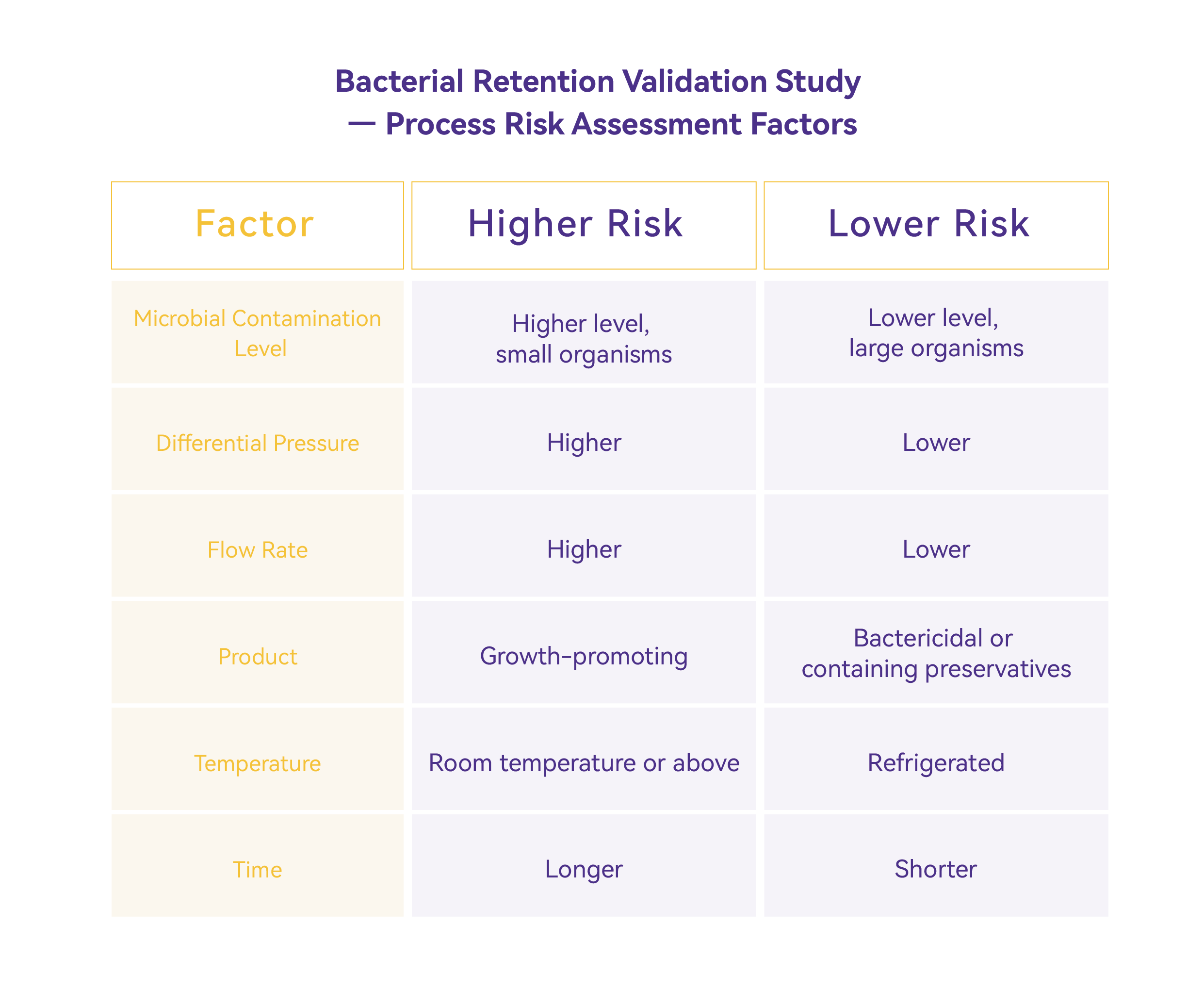
Upon understanding the above information, a risk assessment can be conducted accordingly. Different levels of risk are associated with filtration process parameters; some are related to microbial proliferation in the product prior to filtration, while others are associated with a higher risk of bacterial penetration through the filter.
The figure below summarizes the process risk assessment factors, which can be used to design appropriate validation protocols for specific process conditions.