
What enables a seemingly ordinary depth filter sheet to remove micron-scale—and even sub-micron—impurities? The answer lies in its core skeleton: cellulose. As the essential material of depth filtration media, cellulose quality is a primary determinant of filtration performance—its retention rating, dirt-holding capacity, and process stability all hinge on the fiber's structure and purity.
What Is Cellulose?
Cellulose is the most abundant natural organic polymer on Earth, widely present in plant cell walls, with significant variations in content depending on the source. Global annual production of natural cellulose is estimated to range between 10 and 100 billion tons, yet only about 6 billion tons are effectively utilized.
Besides plants, certain bacteria, algae, oomycetes, and tunicates can also produce cellulose. Cellulose itself is a white, fibrous solid with excellent hydrophilicity and moisture absorption — non-toxic, harmless, and biodegradable — making it the most widely distributed and abundant polysaccharide in nature.
Its chemical formula is (C₆H₁₀O₅)ₙ, consisting of linear chains formed by hundreds to thousands of D-glucose units linked via β(1→4) glycosidic bonds. Each glucose unit contains three free hydroxyl (—OH) groups; the hydrogen bonds formed by these hydroxyls play a crucial role in determining cellulose's physical, chemical, and ultrastructural properties.
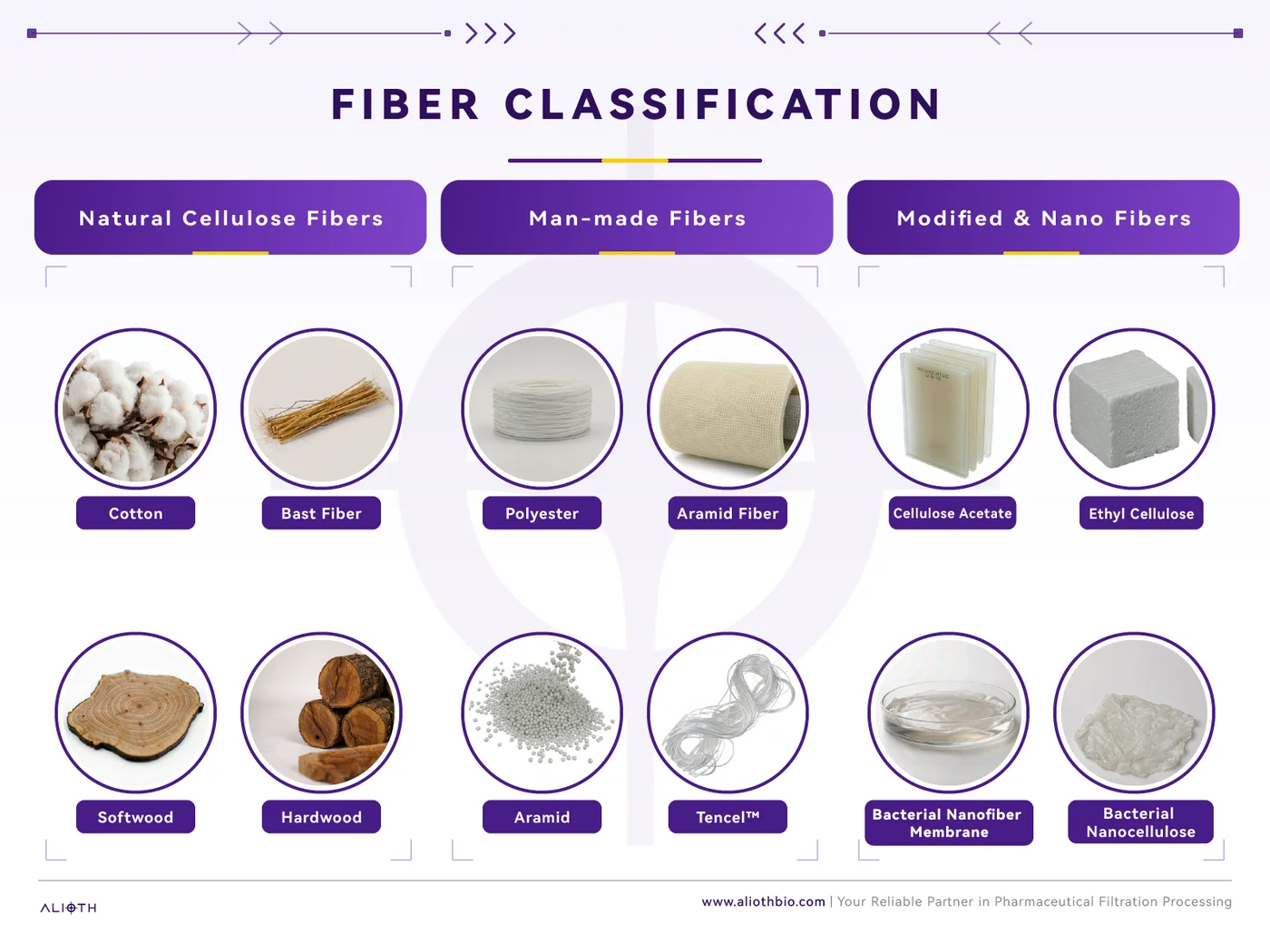
The image below shows common types of fibers available on the market.

The Role of Cellulose in Depth Filtration
Natural cellulose serves as the core framework of deep filtration paperboard and can be constructed into an efficient filtration medium. Its properties directly determine filtration accuracy, contaminant retention capacity, and application stability.
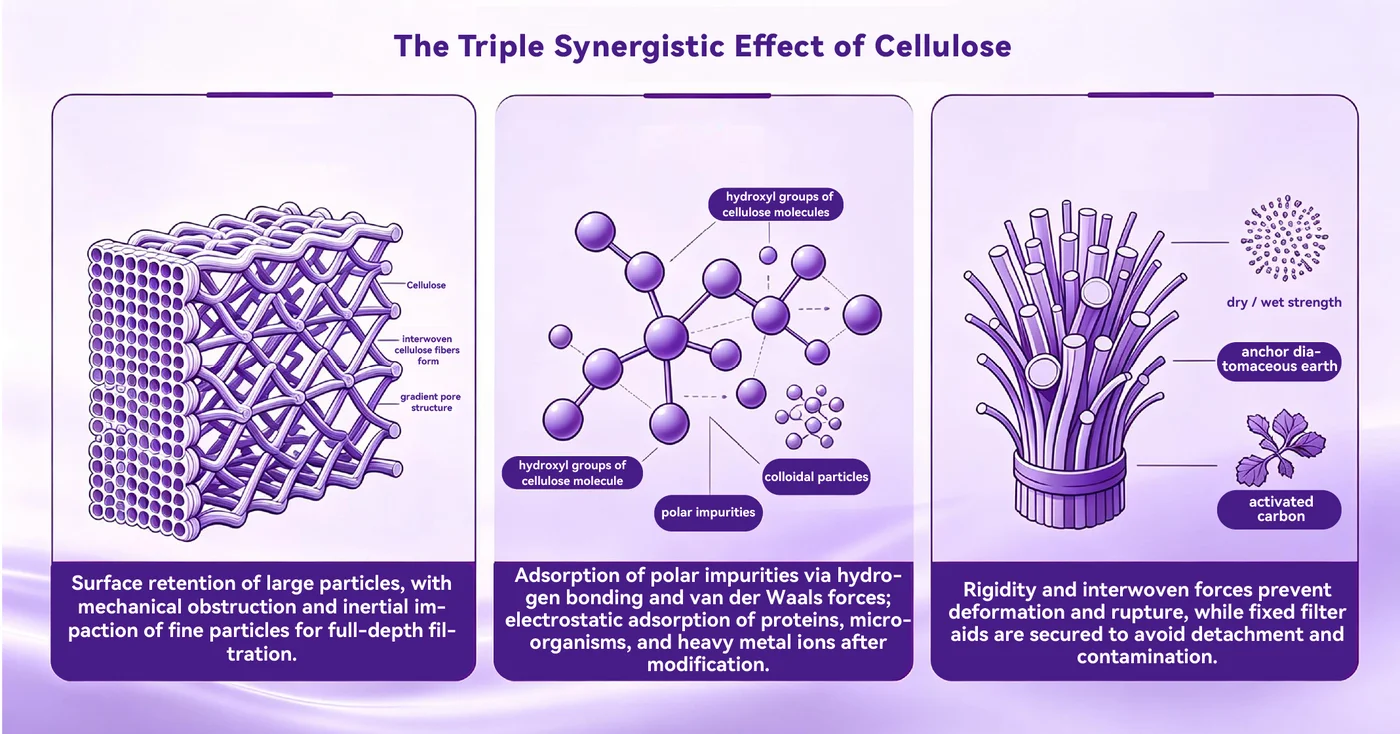
The mechanism of cellulose action involves a synergistic triple effect: physical interception, adsorption retention, and structural support.
Physical Interception
Interwoven cellulose fibers create a gradient pore structure. Large particles are trapped at the surface, while smaller particles penetrate deeper into the medium and are mechanically blocked or captured by inertial collisions within narrow pores, achieving full-depth filtration.
Adsorption Retention
Cellulose molecules contain numerous hydroxyl groups that can adsorb polar impurities and colloidal particles via hydrogen bonding and van der Waals forces. After modification, charged cellulose fibers can electrostatically attract proteins, microorganisms, and heavy metal ions, enhancing fine filtration performance.
Structural Support
The rigidity and interlacing strength of cellulose fibers provide dry and wet mechanical strength to the paperboard, preventing deformation or rupture during filtration. They also securely anchor filter aids such as diatomaceous earth and activated carbon, avoiding contamination of the filtrate.
How Cellulose Shapes Filtration Performance
As revealed by the mechanism of cellulose action, cellulose serves as the core skeletal material of deep filtration media. The three-dimensional porous structure formed by its interwoven fibers not only provides stable support for functional components such as filter aids and resins, but also achieves efficient solid–liquid separation through multiple mechanisms including mechanical interception and adsorption.
The fiber diameter, blending ratio, and degree of fibrosis directly influence the pore gradient and flow-path tortuosity of the medium, thereby determining filtration accuracy, contaminant retention capacity, and fluid resistance.
The hydrophilic hydroxyl groups on cellulose enhance medium wettability and reduce non-specific adsorption of active substances such as proteins. Specially treated celluloses — chemically modified or surface-modified — further strengthen physical and chemical adsorption toward colloids and impurities while minimizing retention of target products, significantly improving feed clarification and product yield.