
Large-scale monoclonal antibody (mAb) production typically relies on centrifugation followed by secondary depth filtration for harvest. At cell densities on the order of 15×10⁶ cells/mL with declining viability, cell debris, colloids, and nucleic acids in the harvest rise sharply, and post-centrifugation turbidity can reach 150–200 NTU.
In such high-turbidity streams, the secondary depth filter is prone to rapid fouling, a steep pressure rise, and premature failure—reducing throughput, raising batch costs, and even compromising downstream feed quality. Maintaining high capacity, low pressure drop, and stable turbidity control under these harsh feed conditions is the core challenge for secondary depth filtration.
This application case, based on a CHO mAb program with high post-centrifugation turbidity, verifies the performance of Alioth’s Alidep® depth filter HA-series secondary filter under extreme feed conditions and confirms its linear scale-up to manufacturing scale.
The turbidity is significantly above normal levels, making clarification far more demanding and putting capacity, pressure drop, and turbidity control to a severe test.
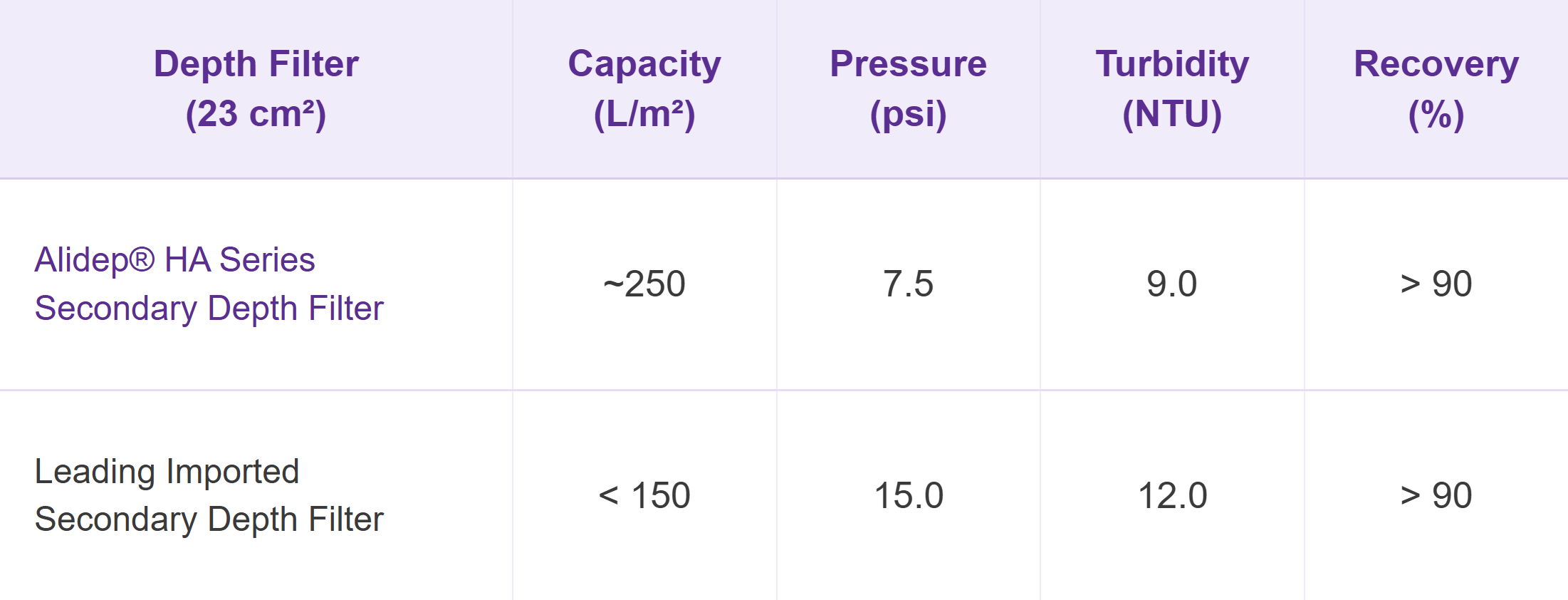
For the high-turbidity post-centrifugation stream, Alioth ran the Alidep® depth filter HA-series secondary filter (23 cm² lab scale) in parallel against a mainstream imported secondary filter.
Even in feed with post-centrifugation turbidity as high as 150–200 NTU, the Alidep® HA-series secondary depth filter still delivered a capacity of about 250 L/m²—well above the leading imported filter’s <150 L/m²—while running at a lower operating pressure drop (7.5 psi vs 15.0 psi), better outlet turbidity control (9.0 NTU vs 12.0 NTU), and recovery above 90%, for a more robust overall clarification performance.
Building on the 23 cm² screening, formal production verification was carried out with the Alidep® HA-series secondary depth filter in its 2,000 L manufacturing format (1.1 m²):
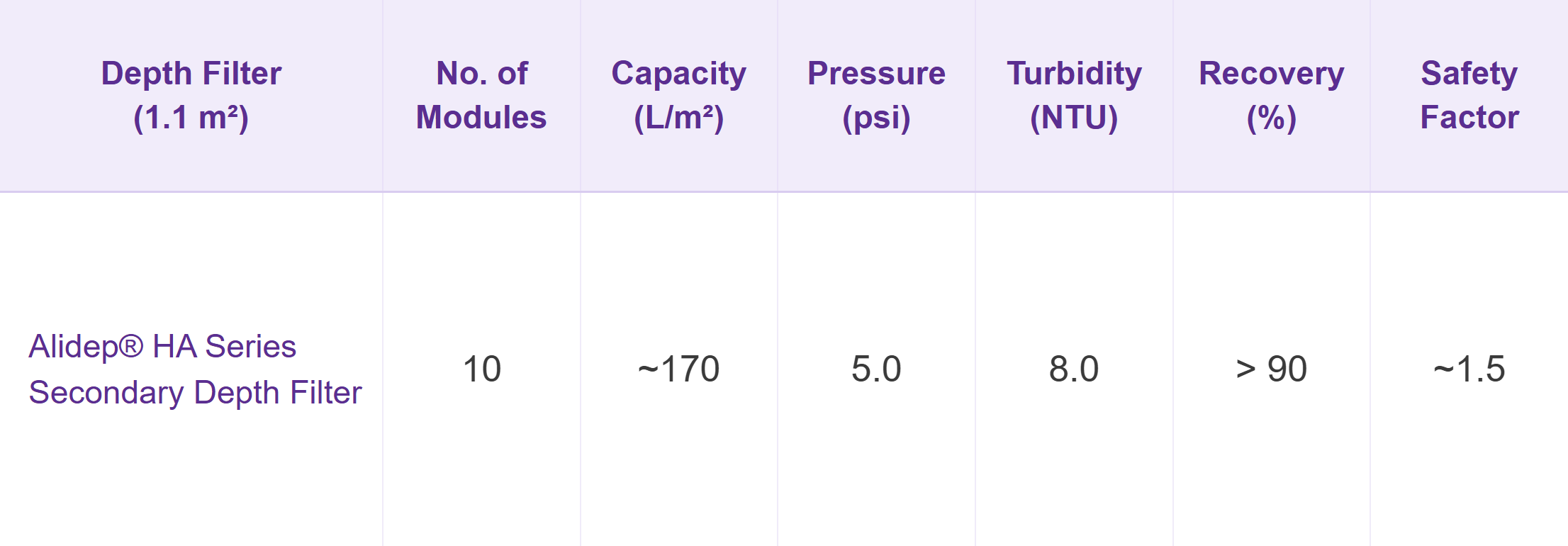
With roughly a 1.5× safety factor reserved on top of the lab-scale capacity, production held linear agreement with the lab scale on pressure, turbidity control, and recovery—confirming reproducibility and robustness at manufacturing scale.
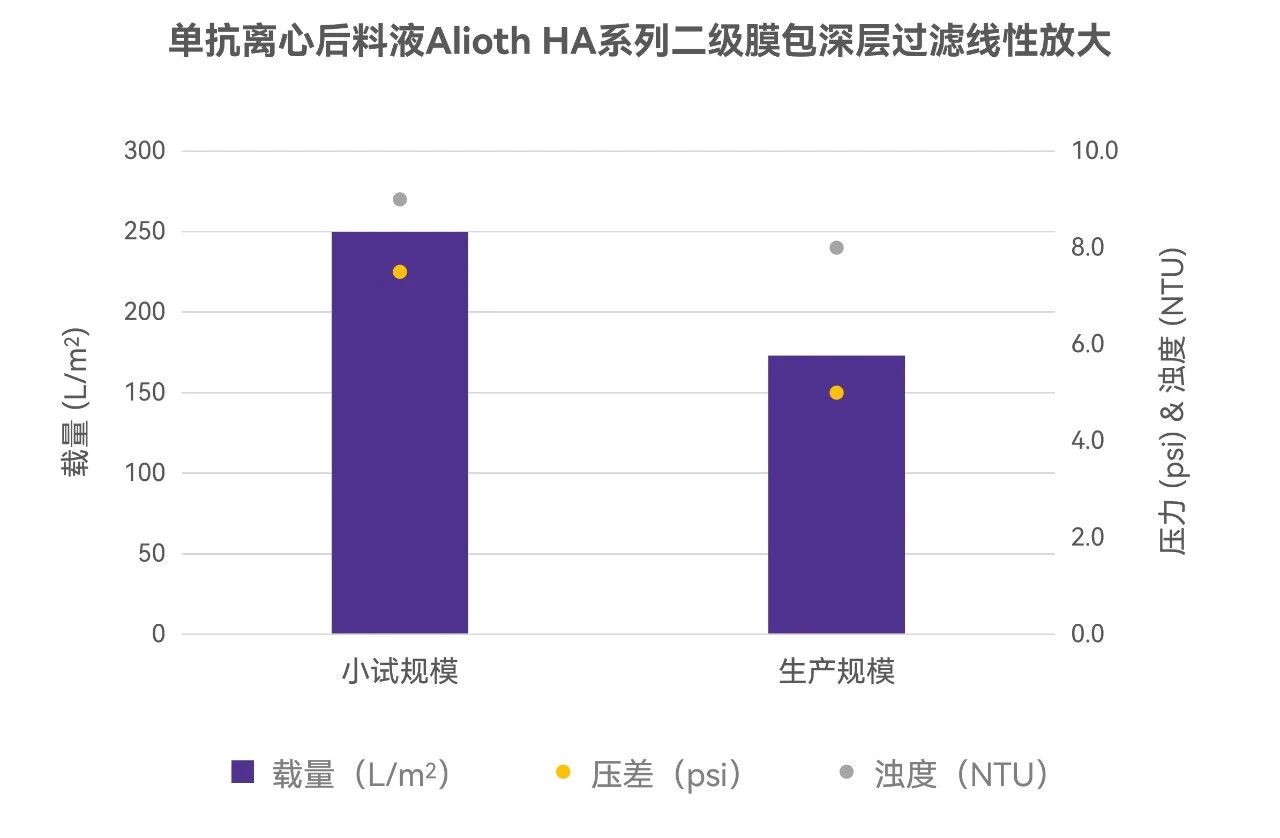
In high-turbidity CHO mAb harvests, Alioth’s Alidep® HA-series secondary depth filter still delivered higher capacity than the leading imported competitor, along with lower pressure drop and better turbidity control, and scaled linearly to 1.1 m² manufacturing.
As increasingly intensive culture processes raise the bar for clarification, Alidep® depth filters—with higher capacity and stronger impurity binding—provide more reliable feed protection for downstream purification.
Request Alidep® depth filter samples and receive a clarification plan tailored to your specific feed characteristics.