
Can integrity testing be performed directly on the product?
Yes, but under specific conditions.
In certain scenarios, the product itself may be the most suitable wetting liquid. Examples include cases where the filter is wetted with the product prior to use to avoid product dilution, where the filter is difficult to clean thoroughly after use, or where reducing cleaning steps post-use is desired to lower costs.
Bubble Point Testing with Product Wetting
Conduct bubble point tests with product wetting on multiple batches of filter membranes and compare the results with the bubble point values obtained using standard wetting liquids to calculate the product bubble point specification. Two methods are commonly available.
Bubble Point Ratio Method
1. Select multiple batches of filter membranes.
2. Perform bubble point testing using the standard solution.
3. After the membrane is dried or the standard solution is thoroughly cleaned off, wet the membrane with the product and perform the product bubble point test.
Upon obtaining the above results, calculate using the following formula (using water as the standard wetting liquid in this example):
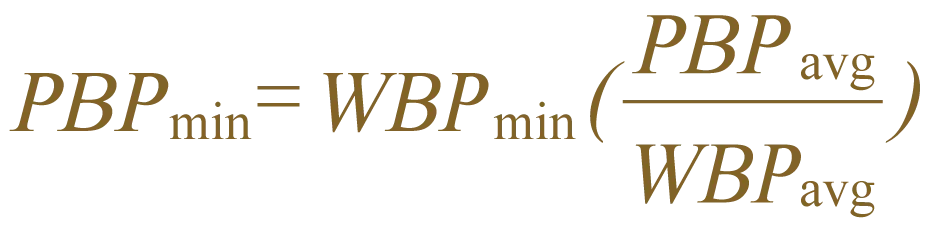
Where:
*PBPmin= Minimum bubble point value with product wetting
*WBPmin= Minimum bubble point value with water wetting
* PBPavg= Average product bubble point measured in testing
* PBPavg = Average water bubble point measured in testing
Statistical Bubble Point Method
Due to the variability of product bubble points, statistical methods may also be used to calculate the product bubble point value, provided the rationale for the selected method is documented.
Based on the Student’s t-distribution, select the appropriate one-sided t-value percentile and confidence level corresponding to the degrees of freedom. This value will be used to calculate the “Corrected Product Bubble Point.” The standard deviation is estimated from the product bubble point test data. These data encompass test variability as well as variability arising from the filter, filter batch, and product batch. All such sources of variation are included because they all impact the product bubble point.

Where:
* CPBP = Corrected Product Bubble Point
* PBPmin= Minimum product bubble point
* tα,dϯ = Value from the Student’s t-distribution table, determined by the α confidence level and degrees of freedom
* s= Standard deviation
Currently, the vast majority of product bubble point testing and calculations employ the first method.