The physicochemical and microbiological properties of steam significantly affect the efficacy of steam sterilization. Substandard steam quality may even lead to sterilization failure.
The following three aspects can help assess steam quality.
Pure Steam
Pure steam is free of pyrogens, chemical substances, particulate matter, and microorganisms, and must be dry, saturated, and free of condensate or non-condensable gases. The condensate from pure steam should meet the Pharmacopoeial standards for Water for Injection. Saturated steam has high heat content, strong heat penetration, and high sterilization efficacy. Wet saturated steam contains moisture, has lower heat content, poor penetration, and reduced sterilization efficacy. Superheated steam has a temperature higher than saturated steam but exhibits poor penetration and low sterilization efficiency. Therefore, dry saturated steam should be used as much as possible during moist heat sterilization.
Feed Water
The feed water for pure steam generators is typically pretreated by reverse osmosis or mixed-bed deionization. Feed water conductivity must be continuously monitored and shall not exceed 5 μS/cm. Silica levels should be below 1 ppm, amines and chlorine below 100 ppb, pH in the range of 5–7, and microbial load below 1000 CFU/mL. Feed water should undergo pretreatment such as filtration, deaeration, and preheating, and should enter the generator at stable pressure and flow rate, minimizing the introduction of non-condensable gases.
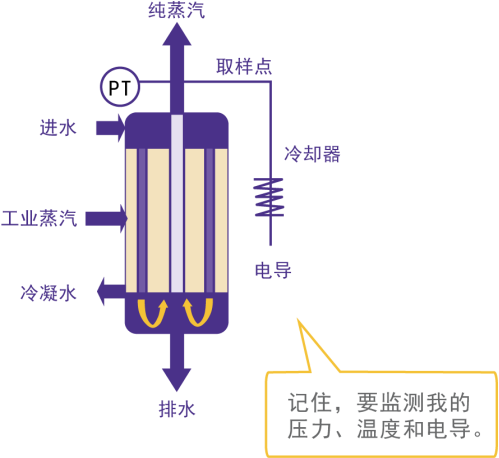
Pure Steam Generator
A pure steam generator is a device that typically uses deionized water as feed water and is heated by electricity or steam to produce pure steam. A pressure maintaining valve should be used to prevent steam pressure from dropping below the normal operating value. Steam pressure fluctuations should not exceed ±10%. Pressure and temperature must be strictly controlled to ensure the generated steam is saturated. The sizing of the steam generator is a critical factor in producing dry steam. Heating 1 kg of stainless steel from room temperature to 121°C within 1 minute requires 1.5 kg/h of steam. Since systems typically contain materials other than stainless steel and are subject to thermal insulation effects from condensate and non-condensable gases, the actual required steam flow rate should generally be calculated by multiplying the steam demand based on the equipment weight by a safety factor of 2.