
Typically, filter suppliers conduct bacterial retention tests on filters using standard solutions; however, such tests and validations cannot represent specific products and processes and are insufficient to validate the sterilizing filtration process for this product.
To determine the appropriate challenge test method, the test microorganism should be inoculated directly into the product (or a surrogate) to demonstrate its survival. The microorganism should be cultured in the same manner as used in the challenge test to preserve its morphological and physiological characteristics. The test exposure time for the survival study should be equal to or greater than the actual process filtration time.
Once the survival test of the challenge microorganism in the product is completed, the challenge method and protocol can be established. The conditions of the bacterial challenge test should simulate the actual production process. Since this test is typically conducted in the laboratory, the test scale should be adjusted accordingly. Flux should be adjusted to flow rate per unit area, expressed in mL/(min·cm²) based on the filter surface area. If the filtration process is controlled by differential pressure, the challenge test differential pressure should not be lower than the maximum process differential pressure.
The figure below outlines the key steps to consider when selecting an appropriate validation strategy for a specific filter and product/process combination.
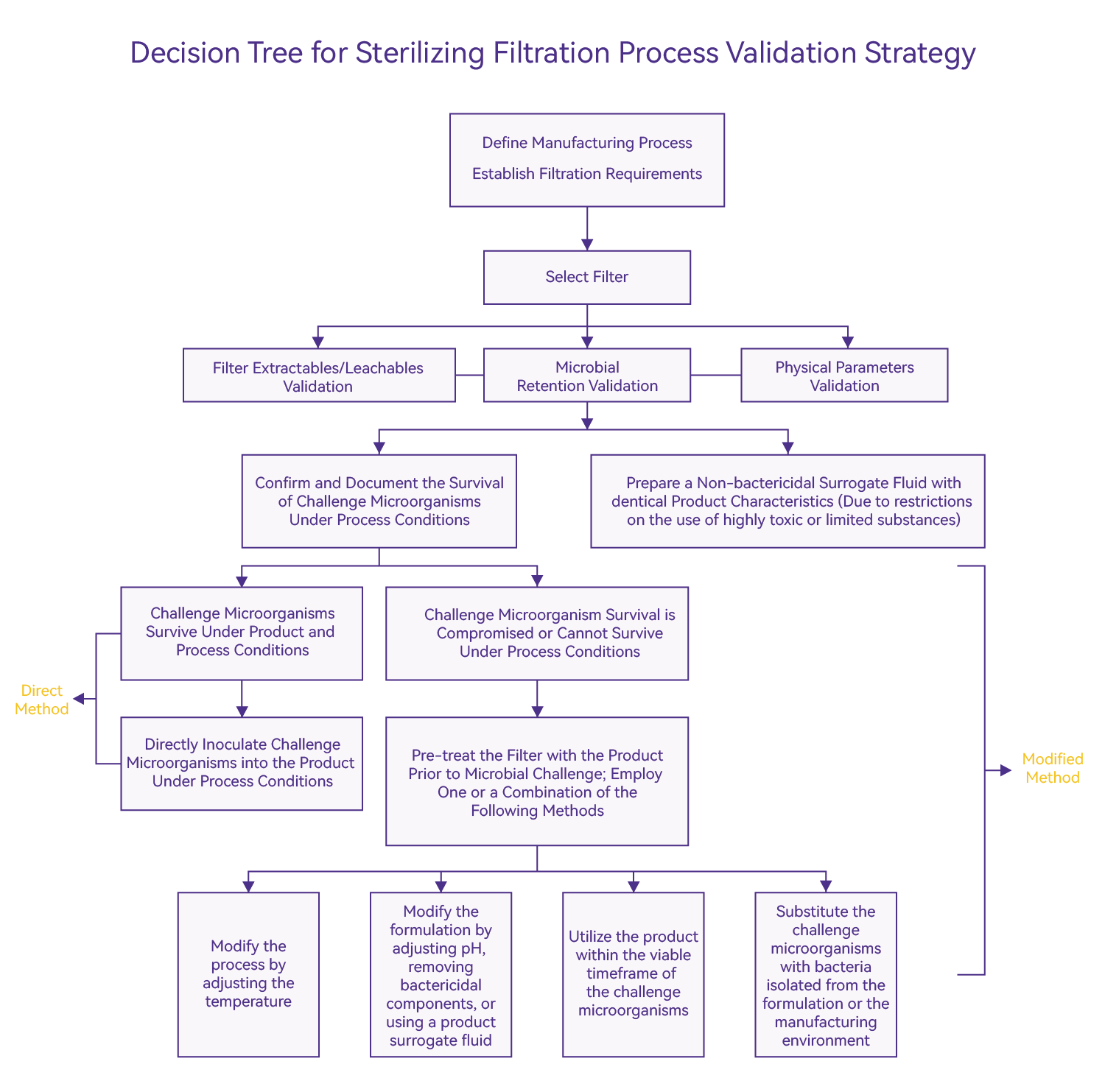
Non-Bactericidal Processes and Fluids
When the product and process fluid have been demonstrated to lack bactericidal efficacy under product and process conditions, direct inoculation of the test microorganism into the product is the preferred method. In such processes, the product should be inoculated with a sufficient concentration of the challenge microorganism under actual process conditions, including time, differential pressure, flow rate, and other critical variables (e.g., temperature). Dilution should be minimized to avoid unnecessary product alteration.
Bacteriostatic/Bactericidal/Non-Diluting Challenge Fluids
Conducting bacterial retention tests in bactericidal products presents additional challenges, such as: what effect the product has on the filter, and what effect the product has on the microbial bioburden within it. Bacterial retention tests performed in bactericidal products or under conditions unfavorable to microbial activity (e.g., high temperature) may not yield accurate results.
To evaluate the potential impact of the product/process on the filter, the filter may be pretreated using the product and actual process conditions, including flow rate, differential pressure, temperature, and time. This pretreatment can be achieved by circulating the product through the test filter in a closed-loop system or by single-pass flow through the test filter, followed by the bacterial challenge of the filter element.
For specific adjustment methods and precautions, please stay tuned for the next installment.