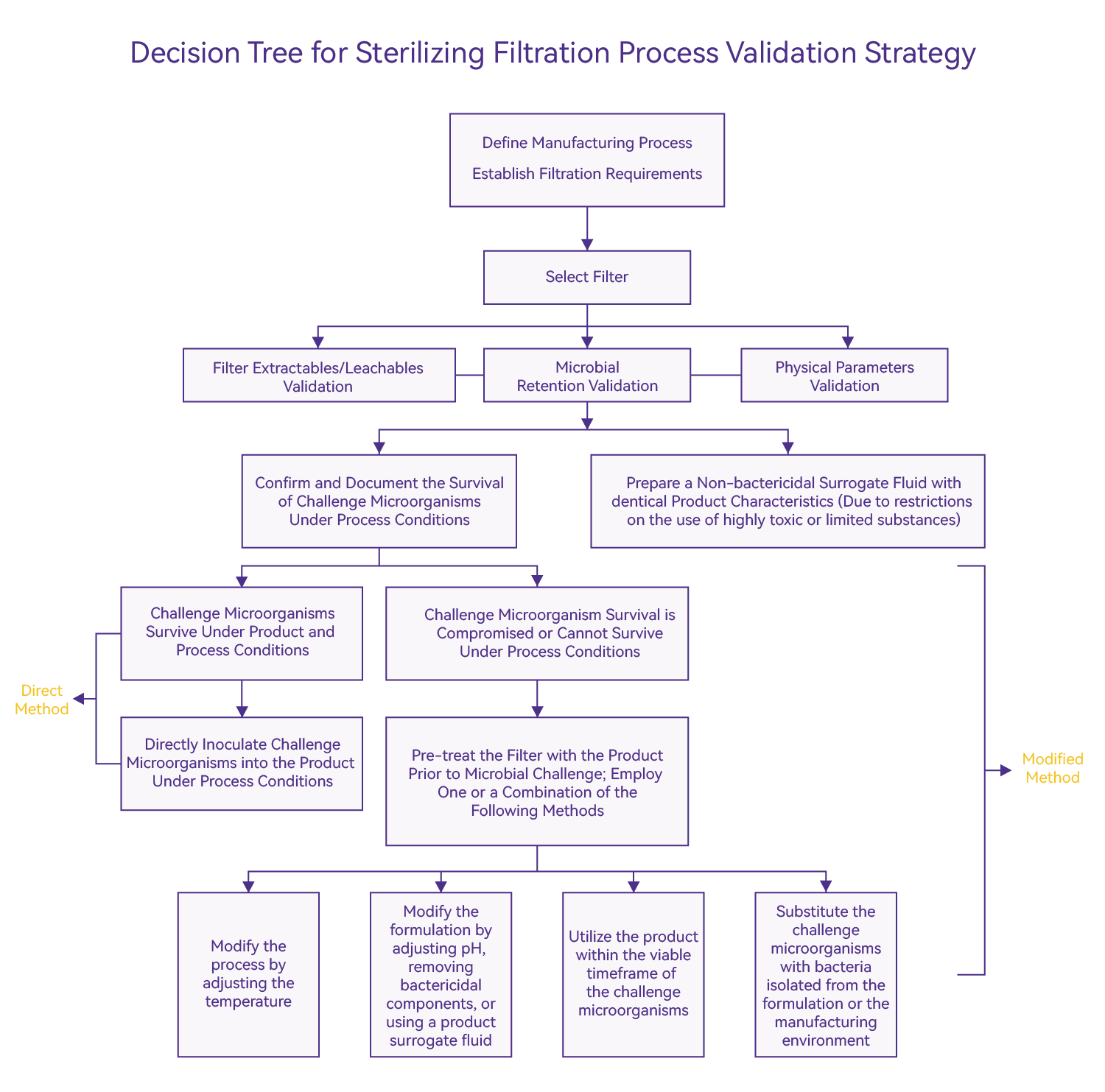
As previously discussed (see background: “Development of Bacterial Retention Validation Test Protocols”), if the challenge microorganisms cannot survive or have compromised viability under process conditions, the test may be performed using a modified approach after pre-wetting the filter with the product. Below are examples of method modifications; in practical application, one or several of these may be combined. Other modifications may also be appropriate if scientifically justified.
01 Reduce Exposure Time
In some cases, challenge microorganisms may not remain viable in the product throughout the entire process duration. A sufficient concentration of challenge microorganisms can be directly inoculated into the product near the end of the pre-wetting phase. It is critical to run a 0.45 μm positive control filter in parallel with the test filter to confirm microbial size and viability.
Alternatively, the challenge microorganisms can be held statically in the fluid to be filtered. Expose the challenge microorganisms to the product at process temperature, and after pre-wetting the filter by circulating the product under simulated process conditions, challenge the filter under worst-case conditions (differential pressure and flow rate). The challenge duration should be reduced to ensure viability of the challenge microorganisms during the actual exposure, challenge, and recovery phases. A 0.45 μm positive control filter should be run in parallel with the test filter to confirm microbial viability.
02 Modify Test Method Parameters
When challenging with bactericidal products, consider modifying test method parameters, typically by altering a single process variable, such as temperature. While this approach may not address all possible process/product/challenge microorganism interactions, it can enable the use of standard challenge microorganisms. After pre-wetting the filter with the product under actual process conditions, modify the bactericidal aspect of the process parameters (e.g., temperature) to perform the bacterial challenge. The product should be directly inoculated with a sufficient concentration of challenge microorganisms.
03 Modify the Test Product Formulation
Another modification involves removing the bactericidal components of the product after pre-wetting the filter with the product. This can be achieved by adjusting the pH to a non-bactericidal range for the product, removing or diluting the bactericidal components, or using a substitute fluid.
The modified formulation should be directly inoculated with a sufficient concentration of challenge microorganisms under actual product process conditions. Bactericidal components should be reduced to levels that do not interfere with the viability of the challenge microorganisms.
04 Use Tolerant Isolates from In-House Microbial Contamination
Although a product may be bactericidal to Brevundimonas diminuta under normal process conditions, other microorganisms may survive under the same conditions. An alternative approach for challenging bactericidal products is to use “in-house contaminant microorganisms.” These isolates are derived from the production environment or product formulation and have been demonstrated to survive in the product formulation under actual process conditions.
The in-house microorganisms should proliferate or remain in equilibrium within the product to ensure that their morphological and physiological characteristics are representative of the process isolates. The smallest or worst-case in-house microorganisms should be used.
If smaller microorganisms are confirmed to be present in the product, these organisms or a suitable model microorganism may be used to challenge the test filter. For example, Ralstonia pickettii grown under harsh conditions may be used. Typically, these challenges are conducted in addition to, rather than in place of, Brevundimonas diminuta challenges.