
In biopharmaceutical manufacturing, sterile liquid filtration is the critical step that guarantees product sterility. Faced with complex process requirements, how do you select the right filter, avoiding product loss while ensuring compliance and cost-efficiency? This article walks you through a complete selection guide for sterile liquid filters — helping you solve filtration challenges and achieve reliable scale-up from lab to production!
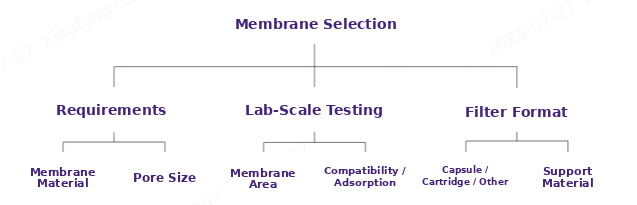
Basic Workflow for Liquid Filter Selection
Overall, the workflow runs from parameter design to process feasibility: first select a membrane that meets the physico-chemical requirements of your process; then validate the required membrane area through small-scale testing; and finally choose the optimized filter format.
I. Membrane Material + Pore Size: Match to Your Process Needs
Three Key Factors in Material Selection
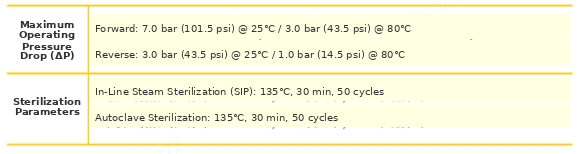
· Physical Resistance:The physical properties of a membrane are reflected in how stable its structure and filtration performance remain under the temperature and pressure demanded by the process. In high-temperature or high-pressure environments, consult the supplier product manual or validation documents to confirm the membrane maximum allowable temperature and operating differential pressure range (e.g., Alioth Alipore® DHC high-flow sterile-grade hydrophilic PES cartridge — see the figure below for its physical resistance, which essentially covers the operating conditions and requirements of biopharmaceutical use).
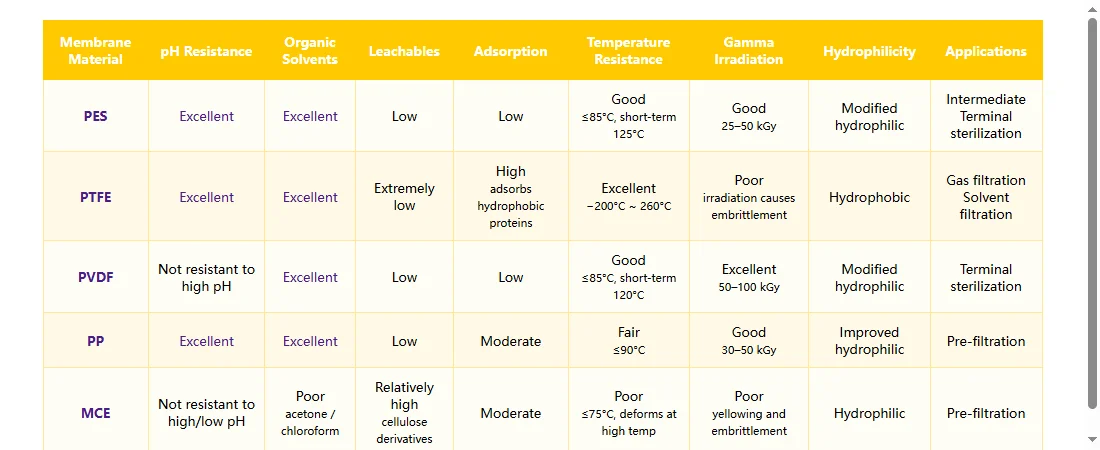
· Chemical Compatibility:A membrane chemical compatibility refers to whether the filter may deform, dissolve, leach, or lose strength upon contact with a liquid. For example, hydrophilic PVDF is vulnerable to organic solvents, while hydrophobic PTFE struggles with aqueous fluids. Under extreme conditions, choose a membrane suited to the solvent type.
· Low Protein Binding:You should also assess the binding tendency of a membrane: free chemical bonds in polymeric media can adsorb your product, causing loss of active ingredients in the filtrate. For high-value products such as collagen or antibodies, low-binding PVDF or surface-modified PES membranes are recommended to avoid yield loss.
· For capsule filters that are gamma-irradiated or intended for irradiation sterilization, also verify that both the membrane and the filter can withstand gamma irradiation.
Reference: Physical and Chemical Properties of Common Liquid Filtration Membranes
Membrane Pore Size and Retention Capability
The core criterion for sterile-grade filters is retention efficiency (≥107Brevundimonas diminuta/cm², per PDA TR26), so selection must match pore-size characteristics:
• 0.1 µm (mycoplasma removal; for media filtration)
• 0.2 µm (standard bacterial retention; terminal sterilization / buffers / intermediates)
• 0.45 µm and above (prefiltration protection; reduces bioburden or particulate load)
For highly viscous, concentrated, or heavily contaminated feed (e.g., serum or collagen), a prefilter (e.g., 0.65–5 µm) is generally recommended to protect the capacity of the final filter.
II. Area + Cost: Validation and Scale-up Strategy
Scale-Down Studies to Pinpoint the Optimal Area
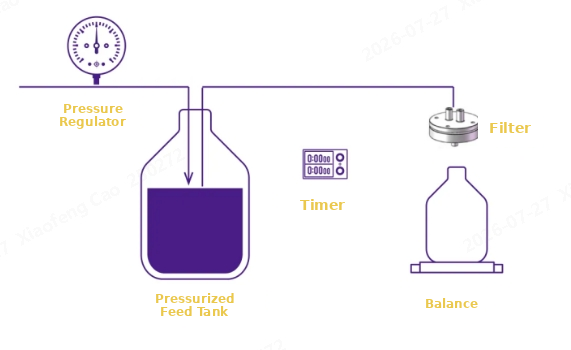
1. Capacity Testing:When only limited feed is available at small scale, a constant-pressure test is typically used (Vmax) — a pore-blocking-model-based method for efficient membrane screening that determines the filter area required at scale.
• Constant pressure maintained throughout
• Measure and record volume versus time
• Calculate Vmax and derive the filter area for full-scale use
The test setup is shown below:
2. Safety Factor:Scale-up typically adds 20%–50% area redundancy to cover batch variation and avoid clogging risk.
Balancing Cost
· Membrane area too small:may clog mid-run, risking costly batch loss.
· Membrane area too large:lowers process risk but raises consumable cost and may reduce yield.
· Golden Rule:Use experimental data models to calculate the point of lowest total cost, balancing efficiency and economics.
Material selection should run in parallel with area evaluation: initial screening often yields several candidate combinations; compare flux and capacity in small-scale tests to pinpoint the optimal solution.
III. Filter Format
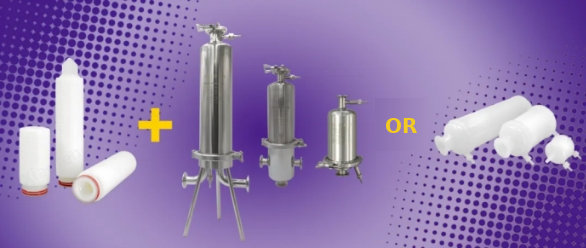
Filters are classified by configuration into two types: cartridge filters and capsule filters. Choose based on your industry and actual process needs, as shown below:
Cartridge Filter VS Capsule Filter
Connections + Flow Direction: Details You Cannot Ignore
Also pay attention to connection type: capsule filters come with various interfaces, such as flange and barbed hose connections.
· Connection matching: flange or barbed hose — match the selection to your piping design to minimize pressure-drop loss.
· Installation orientation: use parallel connections for vertical piping and perpendicular connections for horizontal piping, to reduce turbulent interference.
Summary
Selecting a sterile liquid filter is a technical + economic trade-off. From material matching and experimental validation to hardware optimization, every step must be tailored to your actual feed and process.
Our Services: we provide end-to-end filtration solutions from small-scale process development to scale-up and production validation, custom-tailored to your product profile and budget!