
In our earlier "Filtration Insights" series, we systematically reviewed the concepts of sterilizing filter validation and the validation master plan. This installment focuses on the core component of the validation framework — bacterial retention testing.
Bacterial retention is a critical part of filtration system validation, designed to ensure the performance of sterilizing-grade filters during pharmaceutical production. Through this testing, risks can be effectively managed and compliance assured. Particularly in the final sterile filtration step, bacterial retention testing confirms that filters remain effective even under challenging conditions, thereby protecting product quality and meeting regulatory requirements.
The testing process begins with preliminary confirmation of bacterial viability, proceeds to evaluate bacterial retention, and assesses filtration impact under the most adverse conditions. Ultimately, based on test results and process parameters, the filter is confirmed to produce sterile filtrate under the manufacturer's process conditions.
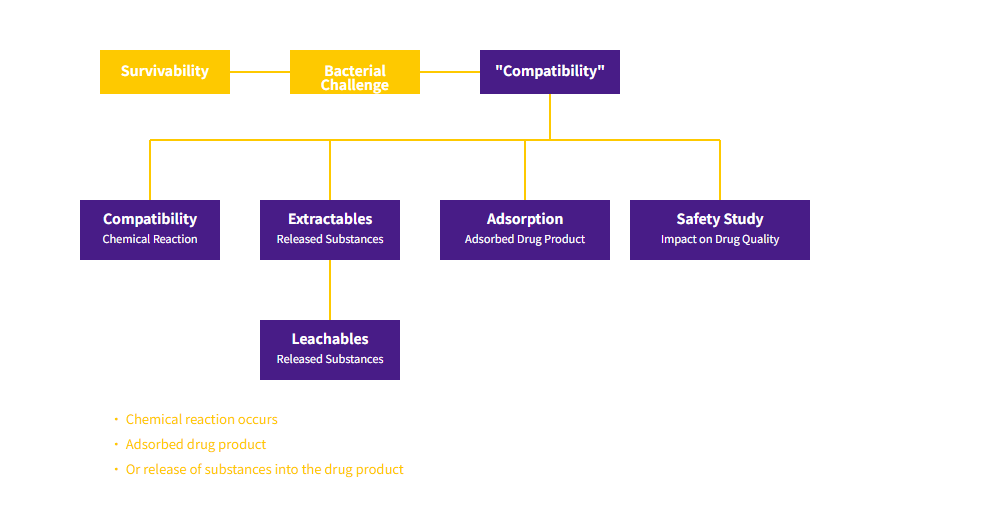
This article primarily discusses the regulatory requirements and implementation strategies for bacterial retention experiments, and also addresses pre-experiment preparations such as adjusting process conditions and challenge microorganisms to ensure experimental validity. It highlights key points of bacterial retention validation, including membrane testing, pre- and post-filtration considerations, acceptance criteria, and investigation procedures. Finally, it outlines the focus areas of regulatory inspections on bacterial retention in recent years, including microbial viability, disc selection, sterilization simulation, differential pressure and dynamic time simulation, and regulatory compliance of challenge levels.
Regulatory Framework and Validation Strategy for Bacterial Retention Testing
In bacterial retention testing, the validation strategy must simulate the worst-case conditions of the actual process to demonstrate that sterilizing filters can produce sterile liquid under high challenge concentrations. The experiment includes viability confirmation, recovery confirmation, and filter retention capability confirmation.
According to GMP guidelines, the viability of microorganisms under process conditions must be confirmed before the experiment. If affected, solutions include adjusting process conditions, formulation, challenge duration, or replacing the challenge microorganism.
Core Elements of Bacterial Retention Validation
By simulating worst-case process conditions in the laboratory, the validation demonstrates that sterilizing filters produce sterile liquid under a challenge of 10⁷ CFU/cm². The validation comprises three modules:
• Viability Confirmation — ensuring microorganisms survive in the drug product
• Recovery Confirmation — verifying the reliability of culture methods
• Retention Capability Confirmation — actual measurement of filter sterilization performance
Why Is Viability Confirmation Necessary?
"Bacterial challenge should be performed by inoculating the challenge microorganism directly into the drug product whenever possible. However, the drug product and/or process conditions themselves may affect the viability of the challenge microorganism. Therefore, before conducting bacterial retention experiments, it is necessary to confirm the survival of the challenge microorganism in the drug product under process conditions to determine an appropriate bacterial challenge method, i.e., the viability test."
— Technical Guidelines for Sterilizing Filtration Technology and Applications, NMPA, October 2018
Currently, microbial culture methods are generally used to confirm liquid sterility. If the test liquid itself has bacteriostatic or bactericidal properties, the validity of the culture results cannot be confirmed and may not truly reflect the sterility status of the sample. Therefore, before initiating formal validation, microbial viability confirmation must be performed to verify whether the target microorganism can survive in the specific feed solution and be effectively cultured.
In summary: if the drug solution contains bacteriostatic/bactericidal components, culture results will be invalid. Confirming microbial viability in advance is a prerequisite for validation validity.
Decision Tree for Sterilizing Filtration Process Validation Strategy
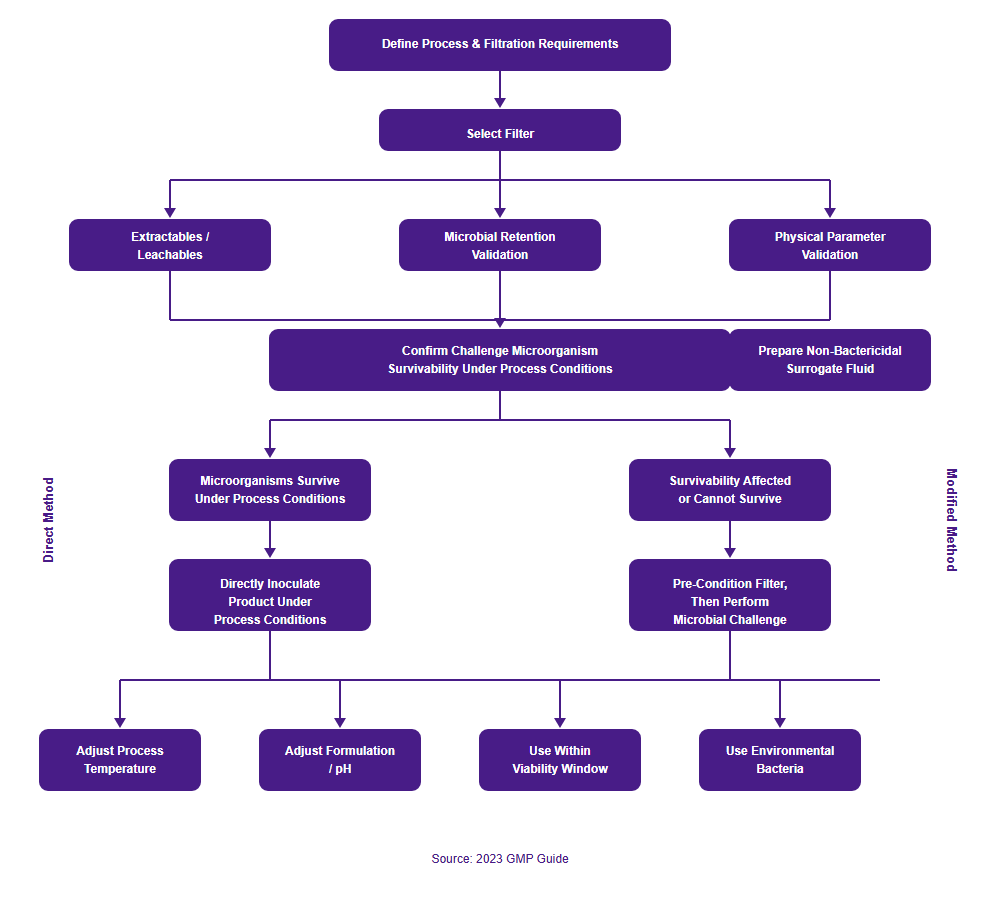
Source: 2023 Edition GMP Guidelines
From the GMP guideline decision tree, it is evident that the viability of the challenge microorganism in the target product and under process conditions must be verified before bacterial retention testing:
• If the microorganism can survive, it is directly inoculated into the product for challenge testing;
• If it cannot survive, the test filter is pretreated with the product (core method), followed by microbial challenge using a fully validated alternative solution.
Several recommendations are available for conducting microbial challenge experiments under alternative approaches:
a. Adjust process parameters: Modify (e.g., reduce) temperature to accommodate microbial survival.
b. Adjust feed solution formulation: Alter pH or remove bacteriostatic/bactericidal components (must be evaluated to ensure no impact on critical product attributes or filter compatibility).
c. Limit challenge time window: Conduct the bacterial challenge within a specific time period during which the microorganism remains viable.
d. Replace challenge microorganism: Select a microorganism isolated from the formulation or environmental monitoring that is more tolerant to the product or process.
Bacterial Retention Experiment Design and Methodology
Having understood the validation strategy for bacterial retention, let us elaborate on the experimental design. Before bacterial retention validation, viability and recovery experiments must be conducted to determine the LRV (Log Reduction Value) of the challenge microorganism under specific contact time and temperature conditions.
• If LRV ≤ 1, the microorganism can survive in the drug solution, and a direct filtration method can be used.
• If LRV > 1, the drug solution may have inhibitory or bactericidal effects on the microorganism, requiring process simulation using bacteria-free drug solution that simulates the worst process conditions, followed by bacterial challenge after adjusting temperature, pH, or flushing the system to remove inhibitory substances.
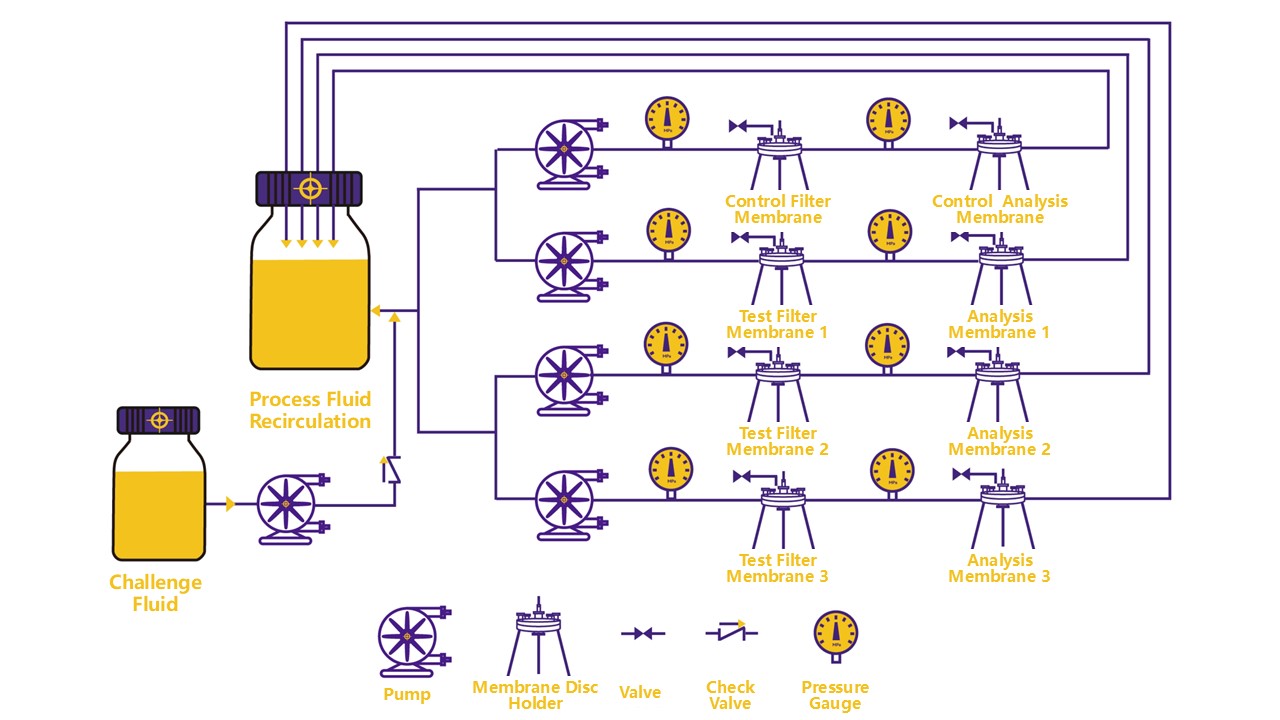
Schematic diagram of bacterial retention test apparatus
Considerations for Worst-Case Conditions in Bacterial Retention Testing
"The purpose of bacterial retention testing is to simulate the worst-case conditions in actual production filtration processes, filtering a product solution or product substitute solution containing a defined quantity of challenge microorganisms, to confirm the microbial retention capability of sterilizing filters."
— Technical Guidelines for Sterilizing Filtration Technology and Applications, NMPA, October 2018
In designing bacterial retention experiments, key parameters must be justified across four dimensions based on the worst-case principle required for validation:
a. Solution properties: Physicochemical attributes such as osmotic pressure (high osmotic pressure may cause microbial shrinkage and increase penetration risk), surface tension, and ionic strength. The conditions with the most significant impact on retention efficiency must be identified.
b. Process parameters: Operational variables such as operating pressure, flow rate, time, temperature fluctuations, liquid pressure, filtration mode, and PUPSIT (Pre-Use Post-Sterilization Integrity Test). The worst-case parameter conditions for these processes should be confirmed.
c. Filter characteristics: Select low-bubble-point membranes as the challenge unit, and ensure the culturability of microorganisms on recovery membranes.
d. Challenge microorganism: When using Brevundimonas diminuta, standardized culture methods must be employed to control cell morphology and activity, ensuring that penetration risk represents the worst-case process conditions.
Key Focus Areas of Regulatory Inspections on Bacterial Retention
In recent years, regulatory agencies have focused on-site inspections of bacterial retention on the following: microbial viability, low-bubble-point disc selection, simulation of sterilization procedures, correct simulation of differential pressure, dynamic filtration time simulation, and whether challenge levels meet regulatory requirements. These key points ensure the authenticity and validity of validation results and avoid regulatory non-acceptance due to improper condition selection.
Conclusion
Bacterial retention testing plays a critical role in sterilizing filtration validation, aiming to test the efficacy of sterilizing filters by simulating the most adverse conditions. This article elaborates on three core steps in the validation process: confirming microbial viability, confirming recovery rate, and validating filter retention capability.
Before initiating experiments, it is necessary to accurately assess the necessity of microbial viability, along with a series of strategies including process adjustment, formulation modification, and selection of appropriate microorganisms to ensure experimental validity and accuracy. Furthermore, we have discussed in depth the considerations in experimental design, such as membrane selection, liquid type, and differential pressure control, aiming to provide filter users with a comprehensive and practical guide for conducting bacterial retention experiments.
Additionally, Alioth provides services for designing and validating filtration systems, aimed at reducing risks and meeting industry standards, while supporting the reliability of data packages for regulatory submissions. This series of services and tests ensures a sterile environment in pharmaceutical manufacturing, complying with regulatory and quality standards.
References
[1] Pharmaceutical GMP Guidelines (2023 Revision), Sterile Products — Volume 1;
[2] PDA Technical Report No. 26, Revised 2008, Sterilizing Filtration of Liquids;
[3] EU Guidelines to Good Manufacturing Practice, Annex 1 — Manufacture of Sterile Medicinal Products, 2022;
[4] Technical Guidelines for Sterilizing Filtration Technology and Applications (No. 85 of 2018, National Medical Products Administration).