
Filtration process validation refers to the qualification procedure executed for a sterilizing filtration process, tailored to the actual production process of a specific drug. It must cover the operational parameters and allowable limits in actual production to ensure reliable process operation under predetermined conditions.
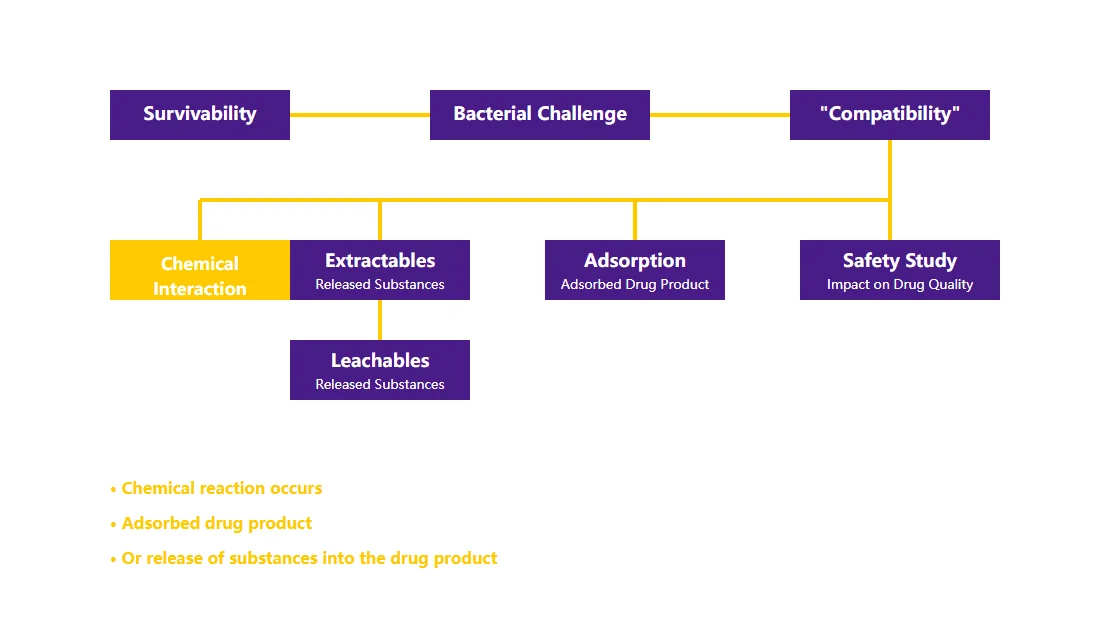
First, it is essential to ensure that the microbial retention capability is not compromised by the properties of the drug solution or process conditions. The impact on microbial dimensions, membrane pore size distribution, and retention mechanisms must be validated, corresponding to the validation item known as the Bacterial Challenge Test (Bacterial Retention Test).
Second, validation must ensure that the filtration process does not alter the critical attributes of the drug, necessitating adsorption studies and extractables/leachables studies.
Additionally, validation requires that neither the product solution nor the filtration process adversely affects the performance characteristics of the filter. This objective is achieved through chemical compatibility studies.
In previous issues, we introduced the concepts of sterilizing filter validation and the Validation Master Plan、bacterial retention testing, and extractables & leachables along with safety assessments. This article focuses on one of the core validation items: Chemical Compatibility Testing
This article is divided into 4 sections:
What is chemical compatibility? Why conduct chemical compatibility validation?
Regulations and guidelines for chemical compatibility studies
Chemical compatibility testing: Standard testing procedures and execution key points
Chemical compatibility characteristics and selection logic for typical filter membrane materials
What is Chemical Compatibility? Why Conduct Chemical Compatibility Validation?
The chemical compatibility of a filter refers to the potential for deformation, dissolution, leaching, or changes in mechanical strength when the filter comes into contact with liquids. The chemical compatibility test aims to evaluate the chemical impact of the process fluid/feed stream on the filtration device under specific process conditions. The chemical compatibility between the fluid and the filter should be a critical consideration during filter selection, and necessary tests must prove that the fluid properties and filtration process have no adverse effects on the filter's retention performance.
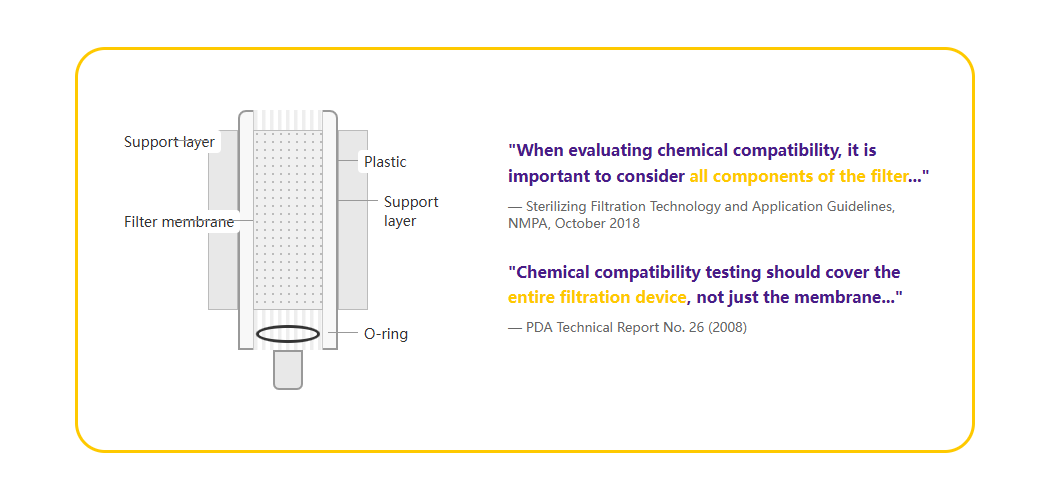
When conducting compatibility assessments, attention must be paid to the overall construction of the filter, including the membrane, support layers, housing, end caps, and O-rings. Compatibility issues between any single component and the fluid being filtered can affect filtration performance and final product quality. Therefore, the validation process should directly test the finished filter assembly used in the actual process.
Chemical compatibility testing should first simulate sterilization conditions, typically employing parameters more rigorous than actual sterilization conditions. It should also incorporate process conditions for contact testing, such as extending contact time or increasing temperature beyond actual process requirements.
To mitigate practical application risks, chemical compatibility validation should not only monitor changes in basic performance parameters but also focus on whether the microscopic structure of the filter membrane has changed. It is recommended to use multiple analytical methods for comprehensive evaluation, rather than relying solely on visual inspection and integrity test results.
Chemical Compatibility Testing: Execution Key Points and Testing Procedures
Based on the aforementioned regulatory guidelines, we understand that chemical compatibility testing evaluates the impact of the drug solution on the filtration device, involving damage assessment of the membrane, housing, and connection components. Key testing points include evaluating all components, simulating worst-case process conditions, using the highest concentration drug to represent the same drug series, cautiously handling filter reuse validation, and recommending that pre-filters also undergo chemical compatibility validation.
Validation Procedure

1. Determine Core Validation Objects
Full-coverage components: Must include all materials of the filter that contact the medium (not just the membrane).
Actual product medium: The use of surrogate solutions is prohibited (unless methodologically validated).
2. Design Validation Conditions
The evaluation process should simulate and appropriately intensify sterilization and process conditions (e.g., increasing temperature or extending contact time) to exceed the rigor of the actual usage environment.
⚠️ Temperature/contact time must be ≥ actual process extremes (e.g., if actual process is 50℃×4h → validation must be ≥ 50℃×4h).
⚠️ Accelerated experiments require justification (e.g., 80℃×24h is equivalent to 25℃×N months).
3. Adopt Multi-Dimensional Testing Methods
During compatibility assessment, the overall structure of the filter must be comprehensively evaluated, including the membrane, inner liners, cartridge cores, and housings. After the contact experiment, multiple performance tests must be conducted separately on the membrane and the complete filter. Generally, the membrane should undergo visual inspection, tensile strength testing, thickness measurement, SEM imaging, and bubble point testing; the complete filter requires visual inspection, flow rate testing, and integrity testing.
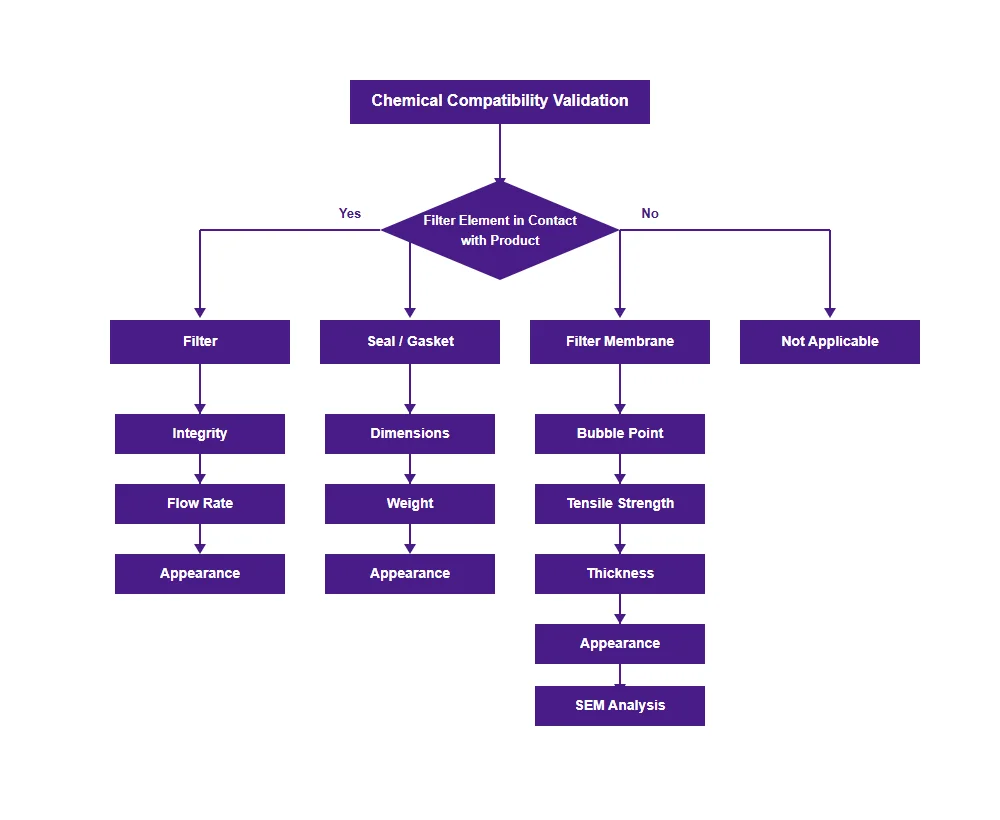
Figure: Chemical Compatibility Reference for Common Filter Membrane Materials
Among all indicators, the integrity test is the most critical, with other results serving as references. If an integrity test cannot be performed, a detailed visual inspection is mandatory.
Critical indicators show no deviation (within error margins) → Judged as Compatible.
Critical parameters exceed limits (e.g., integrity test failure) → Judged as Incompatible.
Chemical Compatibility Characteristics and Selection Logic for Typical Filter Membrane Materials
The chemical compatibility of a filter membrane refers to its interaction characteristics with the filtered fluid. It generally performs well when filtering conventional aqueous solutions; however, the risk of chemical compatibility issues significantly increases in extreme pH conditions (strong acids or strong bases) or in the presence of organic solvents.
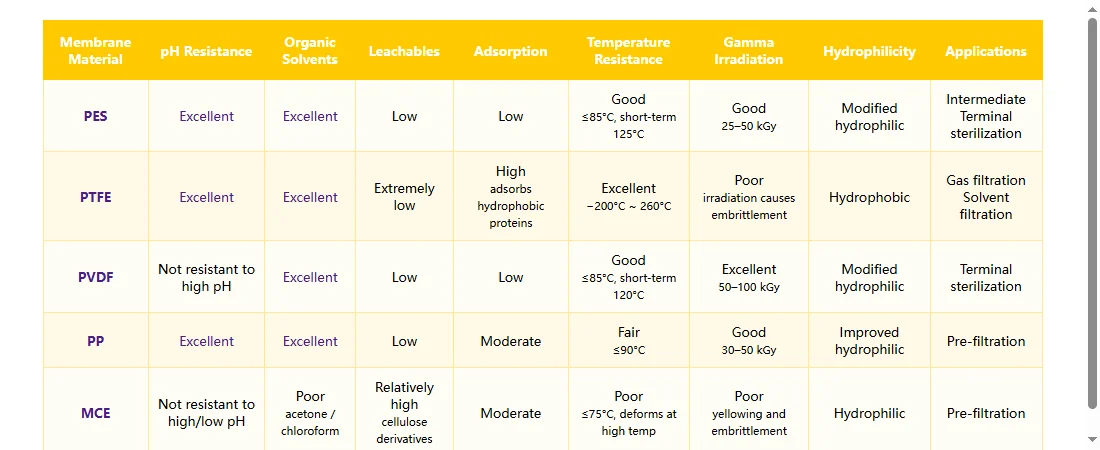
Figure: Chemical Compatibility Reference for Common Filter Membrane Materials
Characteristics and Application Differences of Different Membrane Materials:
PVDF (Polyvinylidene Fluoride) Membrane
Advantages: Good hydrophilicity, mature industrial manufacturing processes, excellent organic solvent tolerance, and extremely low protein adsorption.
Applications: Due to its outstanding comprehensive performance, it is extremely widely used as a sterilizing-grade membrane in biologics and other fields (especially for final sterilizing filtration).
PES (Polyethersulfone) Membrane
Advantages: Excellent and broad pH tolerance range, combined with high filtration throughput and high dirt-holding capacity.
Disadvantages: Poor long-term durability against certain organic solvents.
PTFE (Polytetrafluoroethylene) Membrane
Advantages: Exhibits outstanding tolerance in extreme pH media and high-concentration organic solvent environments (excellent chemical compatibility).
Disadvantages: Due to its strong hydrophobicity, it is not suitable for filtering conventional aqueous solutions.
Applications: Primarily used for organic solvent filtration or high-concentration strong acid/strong base solution filtration.
MCE (Mixed Cellulose Ester) Membrane
Advantages: Good hydrophilicity.
Disadvantages: Relatively limited tolerance to strong acids and strong bases (narrower pH tolerance range).
There is a close correlation between the hydrophilic/hydrophobic characteristics of a material and its chemical resistance, which directly impacts the selection of its applicable scenarios.
Conclusion
Chemical compatibility validation is a core step to ensure the reliability of the filtration process. It requires testing the entire filter assembly (membrane, support layers, housing, O-rings, etc.) under rigorous conditions that exceed actual process limits (higher temperature / longer duration). The impact of the drug solution on the filter is evaluated through multi-dimensional testing (including critical integrity test indicators, visual inspection, tensile strength, SEM, etc.). Material selection must be based on the characteristics and application differences of different membrane materials, while strictly following NMPA and PDA regulatory guidelines, covering the actual product medium and the complete filter device.
References and Guidelines
PDA Technical Report No. 26, Revised 2008, Sterilizing Filtration of Liquids.
Technical Guidelines for Sterilizing Filtration Technology and Applications (National Medical Products Administration Announcement No. 85 of 2018).
National Medical Products Administration. Good Manufacturing Practice for Pharmaceutical Products (2010 Revision). 2011.