
In previous issues of the "Filtration Insights" series, we introduced "validation concepts and the validation master plan"and "bacterial retention testing" for sterilizing filters. This article focuses on one of the core validation items: Extractables & Le
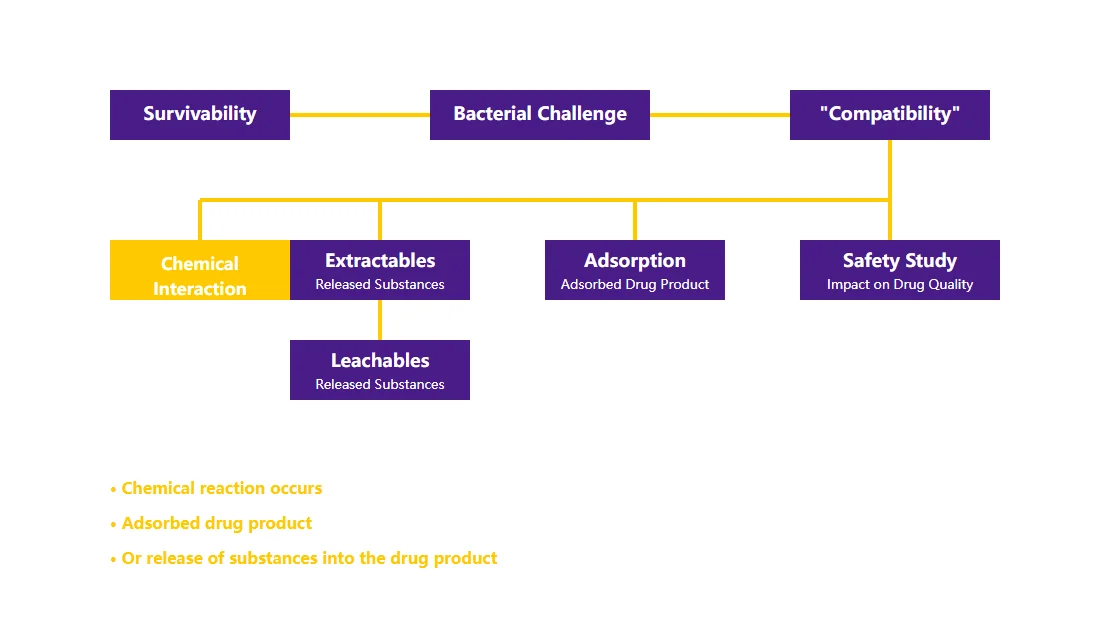
This article is divided into 5 sections:
What are Extractables? How do Leachables differ?
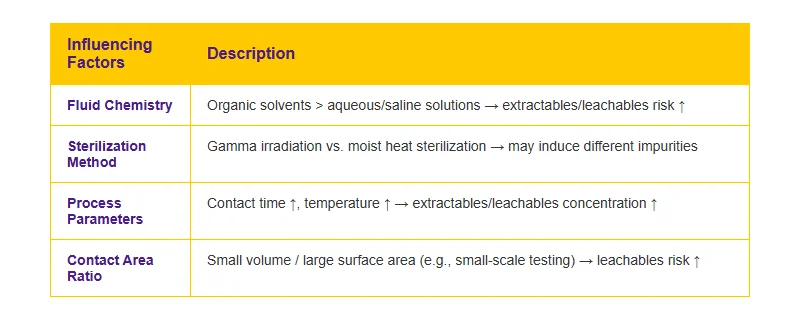
What are the sources of impurities? What factors influence them?
How to conduct Extractables/Leachables validation?
How to analyze validation results?
How to perform a safety assessment?
What are Extractables? How do Leachables differ?
The NMPA's Technical Guidelines for Sterilizing Filtration Technology and Applications (2018) provides the following definitions:
Extractables: Chemical substances that can be extracted from the process media contact surfaces of filters and other component materials under extreme conditions (e.g., organic solvents, extreme high temperatures, ionic strength, pH, contact time, etc.). Extractables can characterize most (but not all) potential leachables that may occur in the process medium.
Leachables: Chemical substances that migrate into the drug product or process fluid from product-contact or non-product-contact materials during storage or under routine process conditions. Leachables may be a subset of extractables, or they may include reaction or degradation products of extractables.
What are the sources of impurities? What factors influence them?
Direct Sources: Filter Materials Themselves
Filter Membrane: Base materials (e.g., PVDF, PES) and additives (plasticizers, antioxidants, surfactants, etc.).
Other Components: End caps, filter housings, O-rings, and other non-membrane parts.
Indirect Sources: Impact of Process Conditions
How to Conduct Extractables/Leachables Validation?
"Leachables are present in the final drug substance and drug product, and are generally included within extractables. However, due to limitations in separation and detection methods and the extremely small quantities of leachables, they are difficult to quantify or qualify. Extractables data under worst-case conditions should be obtained first and used for the safety assessment of the drug product. Extractables reflect the maximum potential for leachables; regardless of whether leachables testing is performed, the testing and evaluation of extractables are critical." -- NMPA Technical Guidelines for Sterilizing Filtration Technology and Applications (2018)
From a regulatory assessment perspective, extractables data is indispensable. Although leachables directly reflect actual application scenarios (including background interference) and are becoming more actionable with improved detection capabilities, CED guidelines specifically emphasize: Extractables represent the theoretical maximum exposure risk of leachables (worst-case conditions). The two are complementary rather than substitutive—extractables define the safety threshold boundary, while leachables confirm routine levels, together forming a risk assessment system.
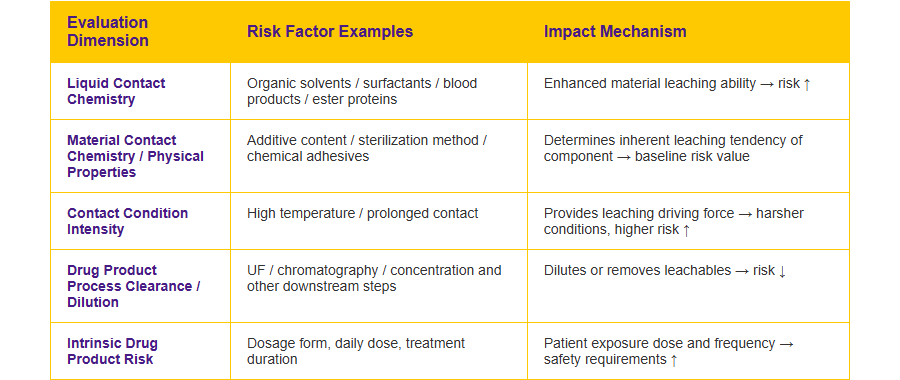
A risk assessment must be conducted before extractables experiments. Not all filtration processes require complex validation. Key assessment dimensions include:
Solution Properties: Aqueous solutions, organic solvents, extreme pH, etc.
Process Conditions: Temperature, contact time, sterilization methods, etc.
Product Risk: Dosage, route of administration, patient population, etc.
Low risk: Exempt
Medium risk: Cytotoxicity testing
High risk: Add in vivo testing
Model Solvent Selection: Low and medium-risk samples use 50% ethanol/water solution; high-risk samples require additional acidic solution (pH=3) and alkaline solution (pH=10).
Tiered Analytical Content:
A. Low & Medium Risk: Basic testing includes NVR (Non-Volatile Residue) and UV absorption.
B. Medium Risk: Add organic extractables testing on top of basic testing.
C. High Risk: Requires comprehensive testing combining extracts from multiple solvents (50% ethanol, acid, alkali solutions).
Expansion of Analytical Methods: In addition to the analytical items for low/medium risk, high-risk testing must supplement elemental testing when necessary.
Organic phase concentration >50%: Using 50% ethanol/water for extraction may no longer be applicable.
Extreme pH (>10 or <3) solutions.
For such cases, experimental protocols must be customized based on actual process conditions to ensure extractables studies more accurately and comprehensively meet regulatory requirements.
How to Analyze Validation Results?
Leachables experiments are typically initiated when the safety assessment of extractables indicates an unacceptable risk to patients.
Before conducting leachables studies, a system suitability study must be executed. This step is crucial to confirm the feasibility of the analytical method and overcome potential interference from the actual drug product.
Next is the analysis of leachables:
Predict potential target leachables based on extractables data.
Prioritize focus on:
Substances detected in high quantities in extractables studies.
Substances with lower detection sensitivity (to avoid missed detections).
Highly toxic substances (even low levels may pose significant risks).
How to Perform a Safety Assessment?
Based on safety considerations and regulatory requirements:
"After completing extractables or leachables testing, a safety assessment should be conducted based on the types and quantities of filter extractables or leachables, combined with the concentration in the final drug dosage form, dosage size, administration time, and route of administration, to evaluate whether extractables and leachables pose safety risks." -- Technical Guidelines for Sterilizing Filtration Technology and Applications, NMPA, October 2018.
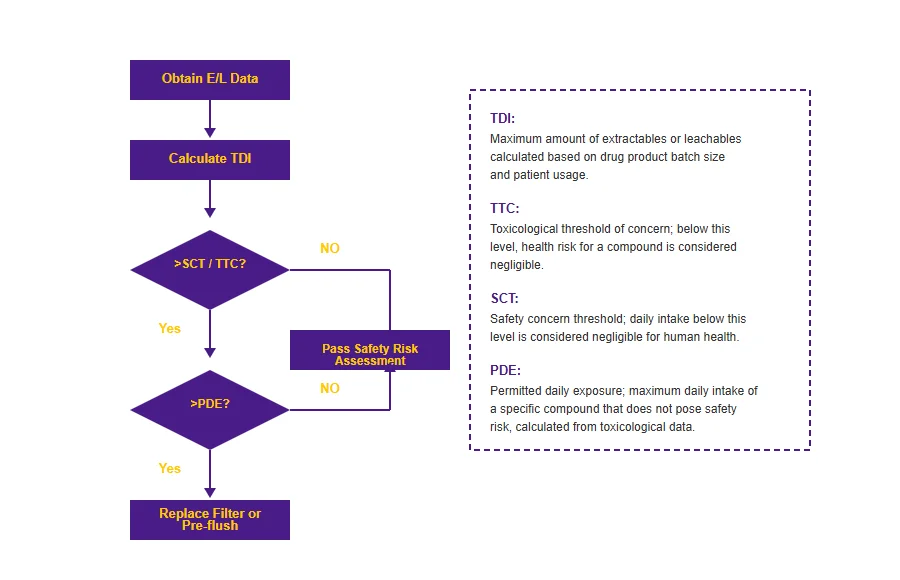
After completing extractables and leachables studies, a systematic safety assessment of the detected impurities is required. The core steps are as follows:
1. Impurity Analysis and Exposure Calculation
Impurity Analysis: Identify the types and quantitative levels of impurities through extractables/leachables studies.
Exposure Calculation: Combine clinical usage parameters of the drug (e.g., dose, dosage form, administration cycle) to calculate the patient's Total Daily Exposure to the impurities.
Execution: Conducted by qualified toxicologists based on exposure data.
Assessment Methods:
A. TTC (Threshold of Toxicological Concern): Applicable to compounds lacking specific toxicological data.
B. PDE (Permitted Daily Exposure): Applicable to compounds with sufficient toxicological data.
Method Selection: The applicability of TTC or PDE must be scientifically determined based on substance characteristics and data completeness.
Acceptable Risk: If Exposure < TTC or PDE value → Risk is negligible; the filter can be safely used in production.
Unacceptable Risk: If Exposure > TTC or PDE value → Risk control measures must be initiated:
A. Process Optimization: Increase dilution factors, adjust process parameters to reduce impurity levels.
B. Analytical Upgrade: Use high-sensitivity methods (e.g., GC-MS/LC-MS) for re-testing.
C. Re-assessment: After implementing control measures, re-execute the safety assessment.
Summary of Process-Based Safety Assessment Strategy
Initial Risk Assessment: Design extractables study protocols based on filter configuration, process conditions, etc.
Negligible Risk (supported by extractables data): Submit directly for regulatory filing.
Non-negligible Risk: Perform quantitative leachables analysis; or re-assess after implementing risk control measures.
Regulatory Submission: Finally confirm risk is controllable and submit the complete evidence chain to regulatory authorities.
C
References and Guidelines
Good Manufacturing Practice for Pharmaceutical Products (2010 Revision).
Technical Guidelines for Sterilizing Filtration Technology and Applications (National Medical Products Administration Announcement No. 85 of 2018).
Bio-Process System Alliance (BPSA) Recommendations for Testing and Evaluation of Extractables from Single-Use Process Equipment, 2010.
USP PF <665>, Plastic Materials, Components, and Systems Used in the Manufacturing of Pharmaceutical Drug Products and Biopharmaceutical Drug Substances and Product.
BPOG: Best Practices Guide For Extractables Testing of Polymeric Single-Use Components Used in Biopharmaceutical Manufacturing, 2020.
ICH HARMONISED GUIDELINE: Assessment and Control of DNA Reactive (Mutagenic) Impurities In Pharmaceuticals To Limit Potential Carcinogenic Risk M7 (R1).
Technical Guidelines for Compatibility Studies of Plastic Component Systems Used in the Production of Chemical Drug Injections (Draft for Comments), 2020.