
In biopharmaceutical manufacturing, gas filtration is critical — it bears directly on product quality, safety, protection of production equipment and facilities, and regulatory compliance. Therefore, selecting a suitable, high-performance gas filter is a major challenge.
Before diving into selection methods, we must first clarify how suppliers define a gas filter's nominal pore size, and what filtration capacity that actually represents. Only by answering these questions can we move on to choosing a good gas filter.
This installment of the "Core Insights" knowledge series brings you an interpretation of how gas-filter suppliers define nominal pore size, the mechanistic difference between gas and liquid filtration, and how to accurately define gas filtration capacity.
Nominal Pore Size
A single product may also be assigned different nominal pore sizes across different applications.
So can the same product be rated with different pore sizes? Or, under different application conditions, do the pore size or filtration capacity actually change?
In fact, the Parenteral Drug Association (PDA), in its Technical Report No. 40 on sterile gas filtration, states:
True pore size must not be confused with the nominal micron rating commonly assigned by filter manufacturers to the various types of filters offered. Such nomenclature is intended mainly for labeling purposes. However, due to the lack of uniformity in the rating from one manufacturer to another or due to different filter materials used, even from the same manufacturer, it is generally not advisable to select a filter for a given application based solely on the numerical micrometer rating . Since different retention mechanisms are involved in sterile gas filtration, a numerical pore size rating has even less meaning than it has in liquid filtration. Most manufacturers designate microbial retentive hydrophobic gas filters as 0.2 micron as areference to "sterilizing" filtration of liquids. These membranes are, in fact, much more efficient in retention in dry gas streams (Liu et al., 1985).
The filter's actual pore size should not be confused with the nominal pore size assigned by the supplier to each product. Nominal pore size serves mainly as a labeling device to distinguish different filters. However, because suppliers lack uniformity in how they grade filters — and even the same supplier may differ when using different membrane materials — it is generally not advisable to select a filter for a given application based solely on its nominal pore size..
Sterile gas filtration involves multiple retention mechanisms, which makes a gas filter's nominal pore size even less meaningful than that of a liquid filter. Most suppliers, by reference to liquid sterile filtration standards, designate hydrophobic gas sterile filters at a uniform specification of 0.2 micron. In practice, however, such membranes exhibit far higher filtration efficiency when filtering dry gas than this number suggests.
So the next question arises: why is the same product so much more efficient at filtering dry gas than liquid?
Mechanistic Difference Between Gas and Liquid Filtration
To explore this, we must first examine how the fluid properties of gas and liquid differ. Compared with liquid, gas has the following characteristics:
Mostly hard particles
Low viscosity
Higher flow rate/ inertia
Lower drag slows particles down
Higher electrical potential difference
To elaborate, although gas and liquid are both fluids, they flow very differently — mainly because of viscosity. The viscosity of most gases is roughly 50 times lower than that of water, so under the same conditions gas flows much faster than water and particles move at relatively high speed. In a membrane-filter model, particles attempting to pass through the filter must actually traverse many channels and change direction repeatedly. Combined with the various gas-filtration retention mechanisms we discussed previously, small particles are very likely to become trapped somewhere in the filter.
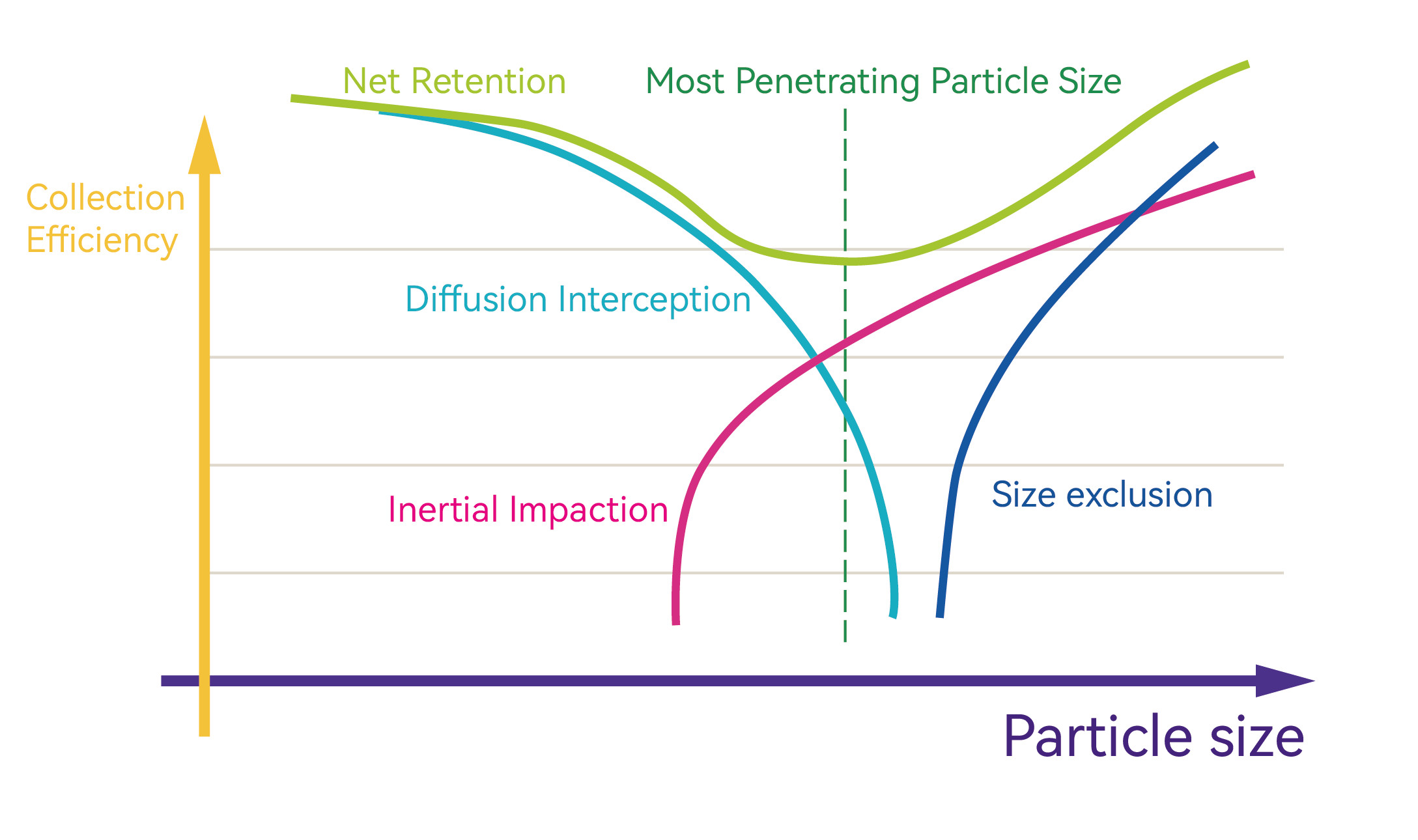
Retention Mechanisms of Gas Filters
In fact, gas filtration employs even more retention mechanisms. Because gas particles have high velocity and high electrical potential, the captured particle size is often far smaller than the filter's actual pore size. Particles larger than the pore are retained by size exclusion; those slightly smaller are captured when they strike the membrane at high speed; and particles far smaller than the pore are trapped by strong electrostatic and diffusional forces.
The following examples illustrate these mechanisms:
First, in microelectronics or semiconductor manufacturing, various gases must be filtered to capture extremely fine particles, which could otherwise cause circuit shorts. This field typically uses rated 0.003 µm filters — filters that are, in fact, the same membranes used in biopharma, all rated at 0.2 µm. In biopharma we call them 0.2 µm because we care more about bacterial retention, but data show they are capable of removing 0.003 µm particles. Note carefully: the 0.003 µm rating applies only to the gas-filtration scenario.
The second example is the sterilizing-grade 0.2 µm filter, which is commonly claimed to retain viruses in gas streams. These filters have been proven to reliably remove virus particles as small as 0.028 µm from gas streams. It must be emphasized that the gas stream creates this high retention performance; if you tried to remove viruses from a liquid stream with the same filter, its viral-retention performance would be greatly reduced.
In summary, the diversity of nominal pore sizes assigned by suppliers stems mainly from the lack of uniformity in how suppliers grade filters. The same filter is rated with different nominal pore sizes for different applications because gas and liquid differ in fluid properties — a dry filter retains particles far more efficiently when filtering gas than when filtering liquid.Therefore, performance in challenge testing is the best definition of a gas filter's pore size and filtration capacity.
So how do you select a suitable sterile gas filter? We will explore gas-filter selection strategies together in the next installment — see you there!