
Previous Knowledge Session — in that session we noted: A filter's true definition lies in how it performs in challenge testing.retention capacity and retention efficiency are among the most critical factors to consider when selecting a sterile filter. Others include:physical durability, compatibility with filtration process conditions, and overall economy.
The relative importance of selection criteria depends largely on the filter's actual application. Combining filter performance with the actual application, for most cases the following characteristics must be considered: retention, integrity testing, flow rate and throughput, and construction materials.
1. Retention
Within the pharmaceutical industry, hydrophobic filters are used in many process steps. Some more critical filtration processes demand very stringent requirements, yet for others such stringent requirements may not be necessary. Overall, requirements for filtration efficiency can be divided into the following categories:
The most stringent applications are sterile-gas applications, where the filtered gas directly contacts sterile product or the critical surfaces of related equipment. Examples include aseptic filling equipment's compressed-air filters,sterile product tanks' protective-gas or breather filters,lyophilizers and critical sterilizers' vacuum-break gas filters. Filters selected for such critical applications should be qualified by an appropriate liquid bacterial challenge test and must undergo appropriate physical integrity testing, which should correlate with the bacterial retention demonstrated by liquid filtration.
The next tier of applications involves filtered gas that does not directly contact sterile product or sterile surfaces. Examples include manyintermediate process steps or venting tofermenters' ventilation applications. For these applications, filters should be qualified by a bacterial aerosol challenge test and should undergo physical integrity testing that correlates with aerosol retention.
Gas filters used solely to reduce bioburden have lower requirements,since expectations for this type of filtration are similar to those for HEPA (high-efficiency particulate air) filters. A dispersed oil aerosol is typically used to demonstrate that such filters meet the requirement.
How to classify a given application under the above scheme and which recommended retention-validation method to adopt require careful consideration. Some cases carry additional or more specific requirements — for example, phage control in certain sensitive fermentations, or viral retention in critical operations. Extensive literature exists on retaining different contaminants, including bacteria and phage, under various conditions and with different membrane types.
2. Integrity Testing
For gas filtration, it can be critical to use a non-destructive physical test to verify filter-assembly integrity and ensure it delivers the required retention. We will cover this topic in detail in a later Knowledge Session.
3. Flow Rate and Throughput
The flow rate of a filter at a given differential pressure depends on several factors, including the membrane type and support material, the medium's thickness, porosity, and pore-size distribution, and its retention characteristics, among others.
For a given filter type, flow rate increases with effective filtration area, though not necessarily linearly. For a specific sterile-filtration process, the required filtration area or number of filter elements can be estimated from clean-gas flow and differential pressure; suppliers typically provide such data as curves or tables. To meet process objectives, the acceptable filter-clogging limit must be accounted for in the calculation. The total system pressure drop should be considered — including prefilters, piping, and the inlet/outlet lines of the sterile-filter housing. Process-specific features such as high-pressure pump speed or steam-in-place (SIP) requirements should also be considered.
Adding a prefilter can greatly increase the sterile filter's throughput. Moreover, a filter's useful life — the effective operating time before the assembly loses integrity — is likely determined not by clogging but by the number of sterilization cycles it can withstand.
4. Construction Materials
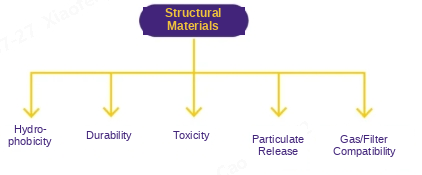
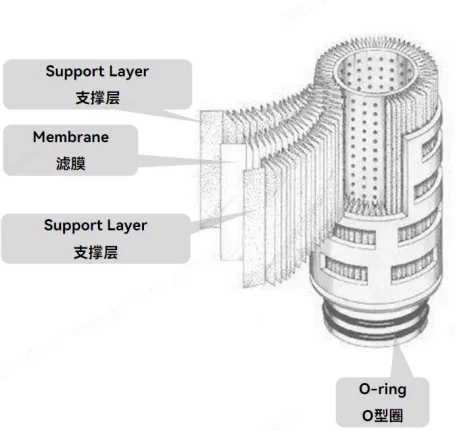
Sterile filter membranes are typically made from polytetrafluoroethylene (PTFE), polyvinylidene fluoride (PVDF), polypropylene, or polyethylene-based polymers. Beyond the membrane, an assembled filter — especially a pleated cartridge — includes upstream and downstream support and drain layers. These support and drain layers usually consist of hydrophobic polypropylene nonwoven media. Some filter cores and O-ring connectors are reinforced with stainless steel or other materials to extend cartridge life. Construction materials affect several key characteristics of the assembled filter, such as heat resistance, chemical compatibility, oxidation resistance, and mechanical properties. Filter users must assess the suitability of the materials used for their specific filtration application.
4.1 Hydrophobicity
To reduce the risk of the assembly clogging due to water accumulating inside the filter — especially within the membrane's pore structure — the construction material should be hydrophobic.Hydrophobicity reflects the relationship between a material's surface energy and the liquid's cohesive energy. Water is the reference liquid, with a surface tension of 72 dyn/cm. As shown below, when cohesive energy exceeds adhesion, water forms beads and does not spontaneously wet the surface.
A substance's hydrophobicity is expressed by the lowest surface tension at which a liquid will spontaneously wet it, called the critical surface tension. Critical surface tension values are listed in the table below; among the common materials discussed, PTFE is the most hydrophobic and polypropylene the least.
Table of Critical Surface Tension of Materials
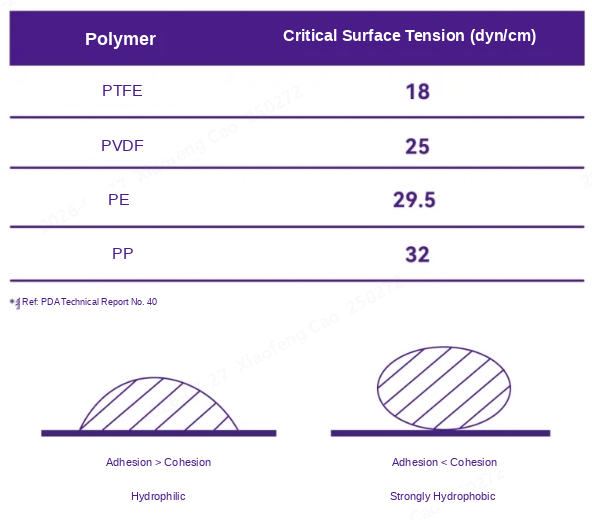
Interaction of Water with Hydrophilic and Hydrophobic Surfaces
4.2 Durability
The filter assembly must withstand the various harsh conditions of its intended application. Filter suppliers typically provide information on the differential pressure that construction materials and assemblies can withstand; the limits on total inlet pressure and on the differential pressure across the filter are usually a function of temperature and flow direction. Users must select filters according to their specific process requirements and operate within the specified limits to avoid integrity damage and the associated loss of retention. When filtering oxidizing gases at elevated temperatures — especially after long-term use — the filter degrades, causing integrity problems. For such applications, an appropriate construction material must be selected, or the replacement frequency adjusted based on the material.
Durability is especially important for steam sterilization. In fact, the economy of some filter applications depends on how many sterilization cycles a given filter can withstand without integrity loss. We will discuss filter sterilization in detail in a later Knowledge Session.
4.3 Toxicity
It is essential to ensure the filtration system does not release toxic compounds into the process stream. Although extractables in liquids receive widespread attention, no extractables can appear without a solvent, so this is not a concern for dry-gas filtration. Nevertheless, most filters should — and typically are — built from materials qualified by standard toxicity testing. Such testing usually requires soaking the filter assembly in various solvents, then evaluating the extracts and the plastic components themselves in animal models and/or mammalian cell-culture assays. These tests ensure the membrane and support materials have no adverse safety impact on the product. Filter suppliers typically provide toxicity data based on the U.S. Pharmacopeia (USP) biological reactivity test, an in vivo test for Class VI plastics.
4.4 Gas / Filter Compatibility
Incompatibility between a filter and the process relates to temperature, pressure, oxidation, or various combinations of these factors. Excessively high temperatures can deform the assembly, while low temperatures cause brittleness and cracking; either extreme can damage integrity. Oxidizing gases may degrade and shed particles from poorly stable support surfaces long before filter integrity is lost — depending on the gas temperature, concentration, and exposure time (the duration of gas filtration).
Because of flammability concerns, polypropylene-hardware filters must not be used to filter pure oxygen. PTFE membrane filters using perfluoropolymer construction materials can be used for pure oxygen; however, if the filtered gas must be sterile, the user must also confirm the filter is sterile-grade, since not all filters are.
In summary, for the vast majority of applications requiring hydrophobic membrane filtration, filters should meet as many of the following ideal characteristics as possible:
The filter must retain microorganisms even under adverse conditions, e.g., high humidity
The filter must have high thermal and mechanical tolerance for long-term use under the required conditions
The filter must withstand repeated steam sterilization
The filter must deliver high flow at low differential pressure
The membrane should be hydrophobic to resist water blockage
The filter should have an optimized construction for a long and reliable service life
The filter should not shed fibers
The filter must allow integrity testing correlated with its retention efficiency
The filter should be easy to install and maintain
The filter's construction materials should suit the intended application (e.g., oxygen filtration)
This concludes the knowledge sharing on "Selection of Gas Filters." In upcoming sessions we will cover integrity testing, sterilization, and practical application examples of gas filters as mentioned above — stay tuned, and thank you for following along.